We have over 100 student organizations on campus, and Championship sports teams for men and women!
Home
>
2026 Archives
>
First Lady Gwendolyn Jackson Brown joins Tuskegee Leaders for Breast Cancer Awareness Workshop
Local NewsFeatured News
First Lady Gwendolyn Jackson Brown joins Tuskegee Leaders for Breast Cancer Awareness Workshop
Crystal Drake24 March 2026
4 minute read
Contact: Crystal Drake, Office of Strategic Communications
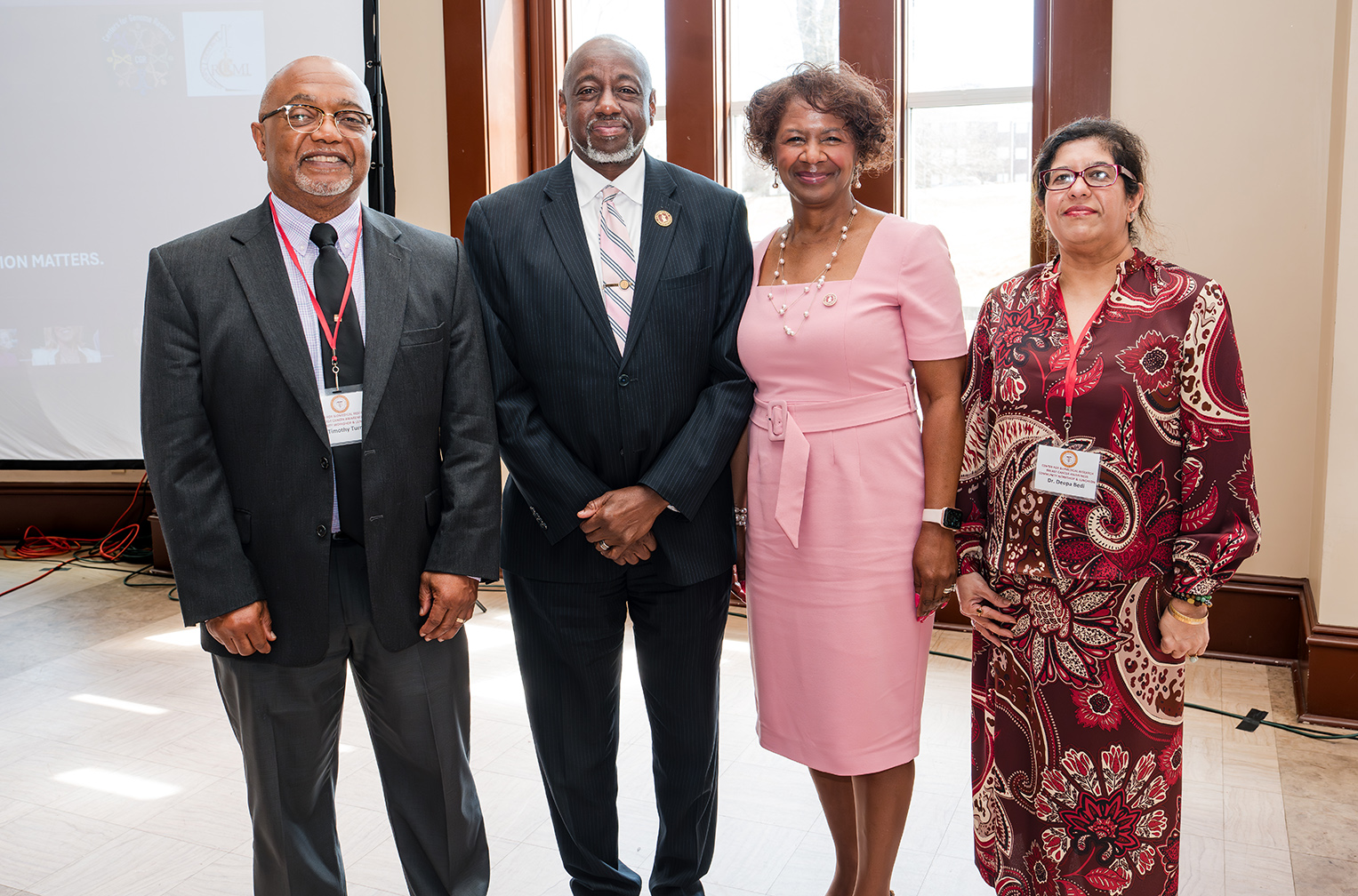
(L-R) Dr. Timothy Turner, Dr. Mark Brown, First Lady Gwen Brown, and Dr. Deepa Bedi
Cancer affects everyone in some way and staffers of the Center for Biomedical Research recently organized a luncheon and workshop to provide support, awareness and to keep the conversation around cancer prevention going.
“We will fight the good fight to ensure that conversation sparks action,” said Tuskegee University First Lady Gwendolyn Jackson Brown who brought greetings. She acknowledged that at some point “your grandmother, mother, sister, aunt, friend, neighbor – and yes, your father, uncle or son,” could be affected by the disease, also remembering her own family members and friends who have battled breast cancer. “Our Renaissance Era focus on cancer research will make more of them ‘the fortunate ones.’ The research being done at Tuskegee University – using tissue samples from our own community – is a true reflection of our head, hand and heart founding principles.”
Access Saves Lives
Dr. Vivian Carter, Community Engagement Co-Lead for the Center for Biomedical Research and Department Head, Psychology and Sociology discussed the role Tuskegee has played for more than 100 years in addressing healthcare for Black people in rural communities and outdated biases that have cost so many lives.
“This is an issue of access – not an issue of education,” she said. “We pay attention to what others miss.”
Last fall, the university broke ground on a $14 million annex to the George Washington Carver Research Center, which will house the Center for Genomics and Health Disparity Research, specifically designed to increase genomic research in the Black Belt. The center is led by Dr. Deepa Bedi, an accomplished researcher and professor of Biomedical Sciences who holds a U.S. patent on technology that more accurately diagnoses metastatic breast cancer.
“Today I am not here as a researcher,” said Dr. Bedi to an audience including Tuskegee faculty and staff and members of the Tuskegee community in the Tomkins Hall Ballroom.
“Most mornings I start my day staring into a microscope at tissue impacted by this horrible disease. I am here today to ask, ‘why is this disease not discussed more in our homes and with no shame attached?’ “said Dr. Bedi, who lost both her grandmother and mother-in-law to breast cancer.
She was certain if they had been better equipped to discuss the symptoms they were experiencing and to access care sooner in the progression of the disease, the chances of their survival would have been exponentially higher.
Dr. Bedi shared key information on how the disease progresses, symptoms, risk factors, and the importance of dismantling barriers to care.
The Tuskegee Way
Cancer research, particularly work that is focused on historically under-researched and under-served populations in the Black Belt, has been a hallmark of the Tuskegee mission for decades and the event celebrated the unity, purpose and hope Tuskegee continues to share with the Tuskegee community – and the world.
“We are here today because Tuskegee University belongs to all of us,” said Dr. Timothy Turner, Vice President for Research, Sponsored Programs and Innovation. “We have always been here for each other, as a university and a community, and conversations like the one we are having today are another example.”
That reach is something James Jackson knows first-hand. Attending the event in support of a member of the Center for Biomedical Research team, he was born and raised in Tuskegee and is now an administrator at Booker T. Washington High School in Tuskegee.
“I spent a lot of time on this campus growing up, in summer programs and other opportunities,” he said about the community impact that has always been the Tuskegee Way.
A Survivor’s Journey
The event closed with the personal testimonial from Laquita K. Allen, Executive Director of Resource Development and External Relations for The College of Veterinary Medicine – and a 10-year breast cancer survivor.
Allen detailed her experience with the disease, which began with her own self-exam. She credits members of the Tuskegee University family for being an integral part of her extended support system.
“Dr. Bedi is my colleague and my friend,” said Allen. “I was able to talk to her about her research in my daily walk through this journey.”
Allen also shared her experiences with disparities in care that, at one point, found her being recommended to have an aggressive surgery that turned out to be unwarranted.
“Educating myself, asking questions, made me an advocate for myself,” said Allen, crediting her uncle for encouraging her to seek a second opinion upon receiving that dire news.
That second opinion, from a physician in Georgia, a Black woman, confirmed that a less extreme surgical option was ideal – and, for the first time, that Allen had two types of cancer. One week later she was recovering from surgery that set her on her way to wellness.
“Fear and faith both existed,” said Allen. “But the fear built my faith. You must embrace the challenges to embrace the journey.”