Contact: Anissa Riley, College of Veterinary Medicine
Crystal Drake, Office of Strategic Communications

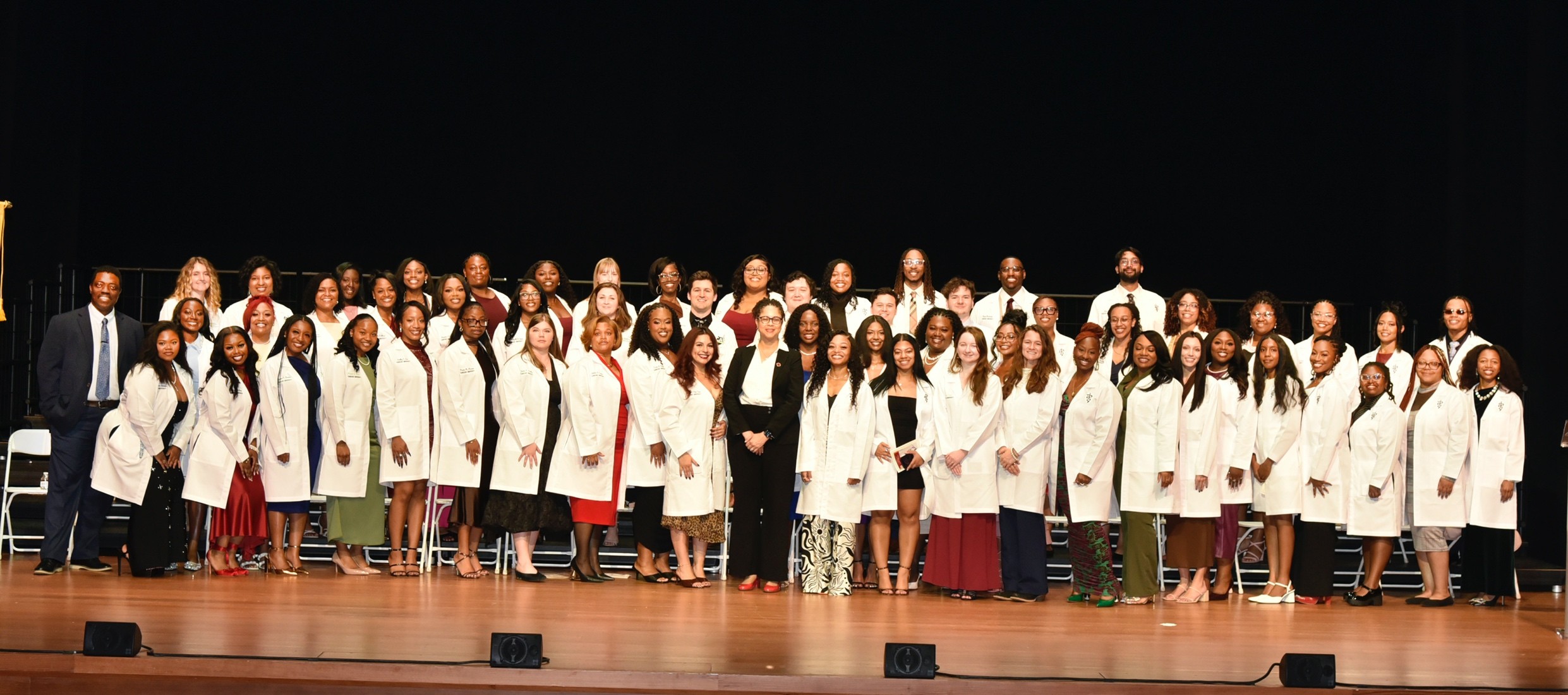
The Tuskegee University College of Veterinary Medicine (TUCVM) celebrated students transitioning from the preclinical phase of veterinary curriculum into the clinical phase of their training at its annual White Coat Ceremony -- honoring 59 students, who will graduate in 2027, as they mark this pivotal step closer to veterinary medicine degrees.
Of all the African American veterinarians practicing in the U.S. today, 75 percent of them graduated from TUCVM. At any school of veterinary medicine in U.S. where the dean is African American, every one of those leaders is a TUCVM graduate. And as shortages in veterinarians across the country continue to spike, TUCVM students are being prepared to fill the gap – most with jobs already waiting for them.
“When our students received their white coats, they did so knowing that most will be fully employed well before graduation—a victory for the State of Alabama, the region, and the nation. It is also a transformational victory for the economic mobility of our students and their families, “said Dr. Mark A. Brown, President and CEO.

The impact these future veterinarians will have is unquestionable. The USDA has identified 243 rural veterinary shortage areas across 46 states, the highest number ever recorded.
“Tuskegee has answered this national call for more than 80 years, with uninterrupted accreditation and a relentless commitment to excellence,” said Dr. Brown. “As we boldly move into Tuskegee’s Renaissance Era, we are committed to expanding the College of Veterinary Medicine's footprint and impact.” A prime example of this progress is construction now underway for a new small animal hospital and preclinical instruction building expected to be completed by 2027.
At the ceremony, special greetings were given by Tuskegee University Provost and Senior Vice President for Academic Affairs Dr. Thierno Thiam, Auburn University College of Veterinary Medicine Dean Dr. Calvin Johnson and TUCVM Dean Ebony Gilbreath.
“They will now move one step closer to becoming career-ready veterinarians and graduating with their DVM degrees next year, joining the proud ranks of veterinarians who have graduated from this historic institution,” said Dr. Gilbreath. “Thank you to our university administration, sponsors, faculty, staff, students, alumni, and of course, the family and friends for your unwavering support of these future veterinarians.”
As family and friends cheered and wept with pride, excitement, and gratitude, one supporter in the crowd, TUCVM Alumni Association president, Dr. Dana Fuller, reminisced that while her white coat ceremony at Patterson Hall is a blur now, she distinctly remembers what it felt like to slip on the crisp, new coat with her name beautifully embroidered on the chest pocket.
“It was an immediate sense of validation,” she said. “It meant something deeply important to know that I was entering my clinicals, closer to being a doctor of veterinary medicine educated at this hallowed place, joining decades of vets before me. And I had known since I was five years old that this is what I wanted, so the white coat was a really big deal!”
Tuskegee College of Veterinary Medicine Class of 2027 president Aaryn DuBose and vice president Ahan Jain emceed the presentation of coats. The white coats for the students from Alabama, Kentucky and South Carolina were purchased by the associations and presented to the students by the president, president-elect, and past president in attendance of the veterinary medical associations: Dr. Jim Lovell (Alabama VMA President), Dr. Lauren Mirus (Kentucky VMA President-Elect), and Dr. Rebecca Hughes (South Carolina VMA Current Past-President and TUCVM ’85 Alumna). Dr. Solomon Odemuyiwa, Interim Associate Dean for Academic and Student Affairs and Ms. Deetra Benn, Director of Student Affairs, presented the white coats to all other students.
TUCVM also gratefully acknowledged the sponsorship and support of Zoetis Animal Health, Banfield Pet Hospital, American Veterinary Medical History Society, Inc., Merck Animal Health, and participation from the associations representing Alabama, Kentucky and South Carolina Veterinary Medical Associations.
© 2026 Tuskegee University