Contact: Crystal Drake, Office of Strategic Communications
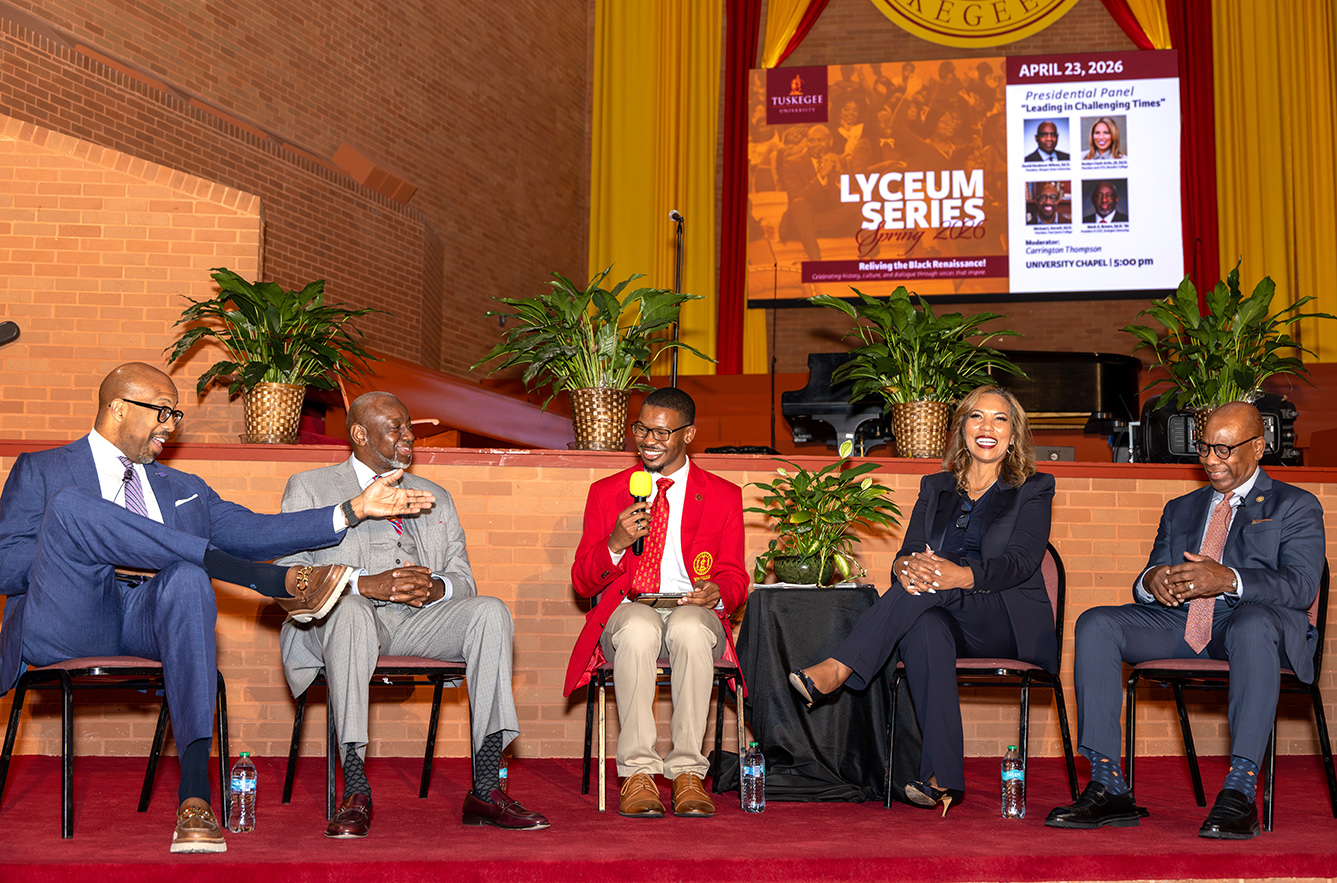 Tuskegee University’s Renaissance Era remains focused on modern interpretations of founding principles that are truer now than ever. The Tuskegee University Chapel was packed with students, faculty and staff gathered for insight from four presidents leading Historically Black Colleges and Universities during extraordinary times.
Dr. Mark A. Brown, President and CEO, was joined by Tuskegee alum Dr. David K. Wilson, President of Morgan State University; Dr. Roslyn Clark Artis, President of Benedict College; and Dr. Michael J. Sorrell, President of Paul Quinn College.
The program, titled “Leading in Challenging Times,” which convened four of the country’s most dynamic and transformational HBCU presidents, was the last session in the university’s Lyceum Series, Reliving the Black Renaissance: Celebrating History, Culture and Dialogue through Voices that Inspire.
The engaging conversation continued the university’s tradition of timely and thoughtful discourse with a powerful conversation centered on leadership, resilience, and the future of HBCUs. Student Trustee, Carrington Thompson, a senior Plant and Soil Sciences major, moderated the discussion.
A Legacy Forged in Resilience
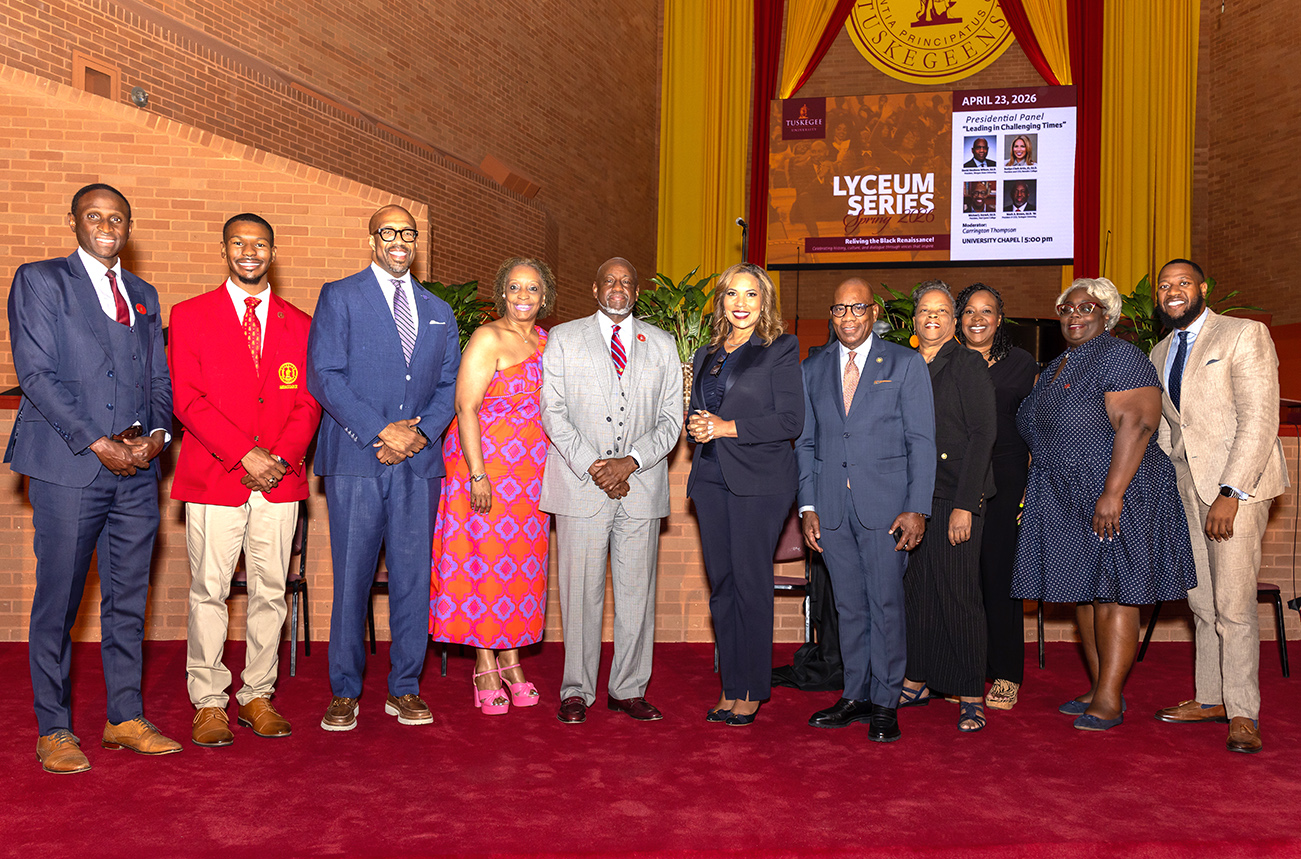 The evening opened with remarks from Provost and Senior Vice President for Academic Affairs Dr. Thierno Thiam, who framed the conversation as both timely and timeless.
“This lyceum is not just a forum for conversation,” Dr. Thiam said. “It honors history, responsibility, and—most important—possibility.” He described HBCUs as “the boldest and greatest experiment in higher education,” institutions born of struggle yet sustained by faith, resilience, and an unyielding belief in the transformative power of education.
Dr. Thiam emphasized that leadership at HBCUs is never theoretical. “It is lived,” he said.
“Against a backdrop of shrinking resources, shifting policy landscapes, and social tensions, courageous, compassionate, and transformational leadership makes the difference between survival and progress,” said Dr. Thiam.
Journeys to the Presidency
Each president introduced themselves by reflecting on the paths that led them to presidential leadership—paths that were often unexpected.
Dr. Artis identified herself as “a daughter, mother, sister, friend—and sister president,” noting that she did not initially aspire to the presidency. Trained as a lawyer, she practiced law for a decade before higher education leadership called her forward.
Dr. Sorrell shared that his own journey began as a college athlete with ambitions of wealth, political office, and even NBA ownership. “I became president by accident,” he said, recalling how he was the last choice for a job few wanted when Paul Quinn College was on the brink of closure. He was able to see the dire circumstances as rich with possibilities.
“In a moment like that you are free – free to experiment, to cast a different vision. For the entirety of your lives, what I hope for you is that you don’t limit yourself to others’ vision of you. You decide who and what you will be,” he said to students noting that the role, which he has now held for 19 years, has been “the greatest gift I could have asked for.”
Dr. Wilson reflected on his extensive career in predominantly white corporate and academic environments, including becoming the first Black vice president at a predominantly white institution in Alabama while at Auburn University. But when the opportunity arose to lead Morgan State University, and upon the urging of his father to “come home,” Dr. Wilson accepted the presidency role, where he recognized the familiar spirit and excellence he once experienced at Tuskegee.
Dr. Brown shared that as a Tuskegee student, he never imagined himself as president. Commissioned as an Air Force officer after graduation, he planned to serve four years and then enter the private sector. That four-year plan grew into a 32-year military career, culminating as a Major General. Ultimately, Dr. Brown said, Tuskegee’s transformative impact on his life drew him back. “I didn’t want to be an HBCU president,” he said. “I wanted to be Tuskegee’s president.”
Leading Without All the Answers
When asked how they lead amid uncertainty, all four presidents emphasized humility, collaboration, and trust in others.
“There is not a single day that I have had all the answers,” Dr. Brown said, stressing the importance of surrounding oneself with people who are smarter and more expert in their fields. Dr. Wilson echoed that sentiment, explaining that effective presidents must know “a little about everything,” while cabinet members possess deep expertise in specific areas.
Dr. Sorrell added that curiosity and a willingness to “fail fast and move on” matter as much as knowledge.
“I don’t have all the answers but the one thing I am an expert at is being relentless,” he said.
“I am an expert at being relentless in the pursuit of the dreams that my students have.”
He has introduced a game-changing operating model at Paul Quinn that he says likens the institution to a start-up incubator that requires every student to start a business before they graduate.
“You will either graduate with a job or creating jobs. “We want to end cycles of generational poverty that have wreaked havoc on our communities for far too long.”
Breaking Barriers—and Ensuring Continuity
As firsts in various contexts, the presidents addressed the responsibility of ensuring they are not the last.
Dr. Artis became Benedict College’s first woman president in its 137 year history, and spoke candidly about the irony that it took so long for her historic presidency given that Benedict was founded by a woman. She discussed the pressure of representation adding that challenges and critics cannot outweigh her responsibility to future generations of women leaders, as many young women in the audience met eyes with her, nodding with quiet understanding.
Dr. Wilson highlighted Morgan State’s transformation under his leadership—now the third-largest HBCU in the nation, with expanded enrollment, capital investment, endowment growth, and more than 150 degree programs, including 36 doctoral offerings. He emphasized his commitment to mentoring others, from rising leaders in academia who might one day be future presidents, to engaging MSU students directly through a presidential leadership circle.
He shared that when he meets with students he tries to make it very plain for them that, “when we say we are growing that future, that is you and this is what it means to be a leader.”
Dr. Brown urged students to think about leadership as an art, more than a science, a set of skills that are refined through practice. He has challenged his Cabinet, faculty, and staff to create opportunities for students to learn to lead by literally doing it.
By leading student organizations, athletic events, and campus initiatives, he said, Tuskegee students are already preparing to sit in the seat he holds today. “It won’t take another 144 years for a Tuskegee alum to become president, because you are practicing the art of leadership each and every day.”
Reimagining the Future of HBCUs
Looking ahead 15 years, the presidents offered distinct but complementary visions.
Dr. Brown envisioned a future where students graduate with zero student loan debt, free to pursue passions rather than repayment obligations.
Dr. Artis described the current moment as a national awakening to the unique value of HBCUs—a chance to bring them into the mainstream as engines of global transformation.
“Those of us who have had the benefit of attending an HBCU already know and understand the special sauce, because we are phenomenal by every single measure,” she said, herself an alumna of West Virginia State University.
“People outside the HBCU community are recognizing the unique and inherent value of an HBCU education,” she said. “This is a moment, a movement and an opportunity to show the world who and what we are and to educate kids of color to go out across the globe and quite literally transform the world.”
Dr. Wilson expressed his hope that HBCUs would be recognized as central to saving American democracy and that they achieve significantly expanded endowments and research capacity. Sorrell offered a different perspective, advocating economic independence for small, private HBCUs. “There is room for all of us,” he said, emphasizing models that allow institutions to remain “unbought and unbossed,” echoing a phrase made famous by Shirley Chisholm, the first Black woman to run for president of the United States.
Students at the Center
During the question-and-answer session, student Deirdre Faye Newcombe, a first-generation college student and aerospace engineering major, asked how leaders prioritize amid limited resources. Dr. Sorrell responded by affirming her journey. “You are who you are looking for,” he said, encouraging her to continue looking to the personal fortitude and intellectual curiosity that had brought her this far.
Dr. Brown reinforced that every decision he makes for Tuskegee begins with one question: What is best for students?
Dr. Artis and Dr. Wilson echoed that sentiment, reminding students that Tuskegee itself was built by students who took what they had and made what they needed.
“Tuskegee has never failed me,” Dr. Wilson told the crowd.
“I left this place, confident, competent, and I knew when a door opened for me, I should go in that room, not be inebriated with the fact that I was there or that I was first, but I needed to show those in the room that I was more prepared than anyone there.”
He urged them to take advantage of the rigor and discipline that Tuskegee requires of them, noting that his professors remain “legendary.”
“They did not compromise their standards or expectations. As a result, you have Tuskegee students all over the world – leading. You will be too. You will raise the bar, set the standard and show them what the model of excellence is.”
© 2026 Tuskegee University