Contact: Crystal Drake, Office of Strategic Communications
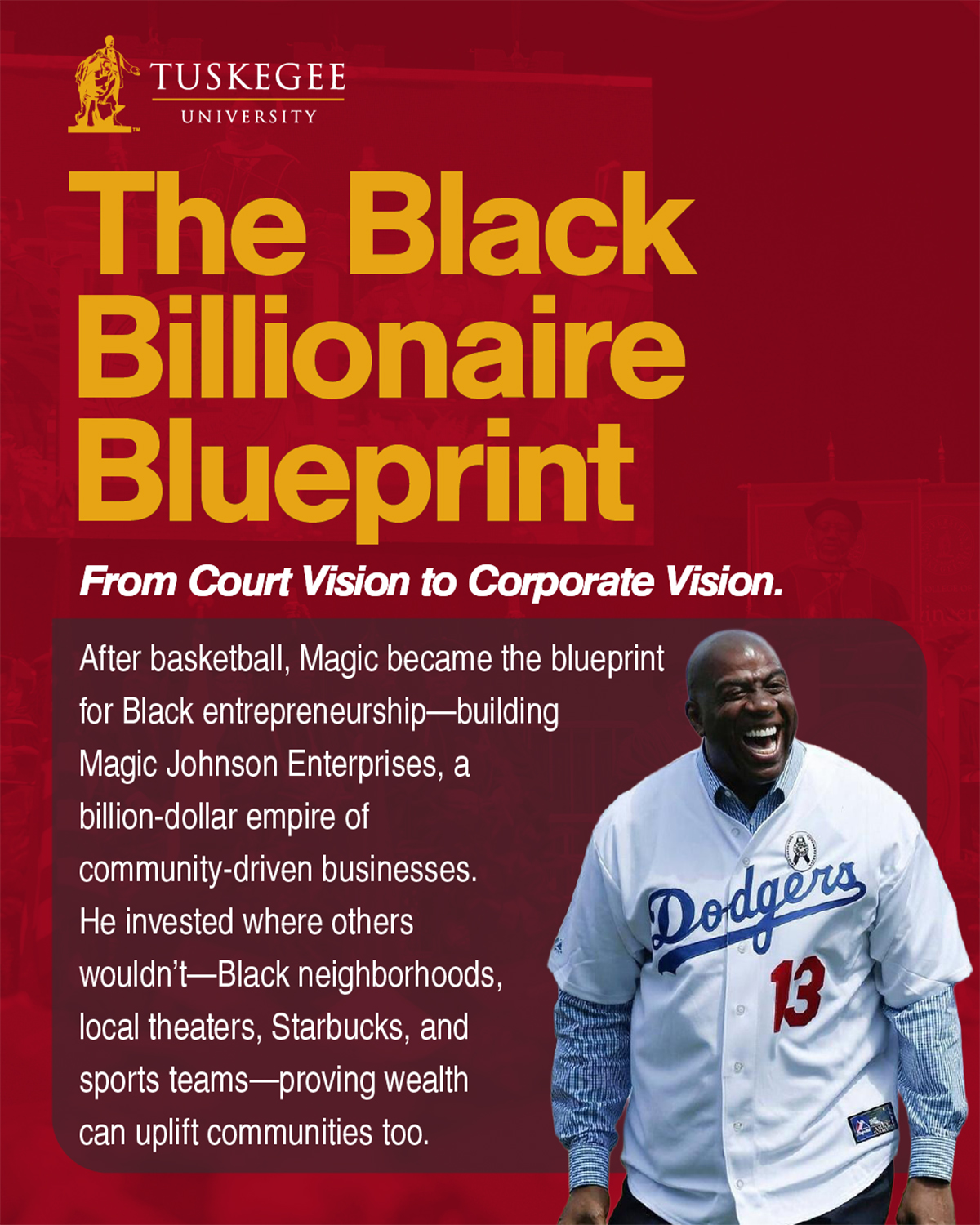
Long after he retired from basketball, Magic authored a second act that has become a living blueprint for Black generational wealth, ownership, and business expansion—one rooted not in celebrity hype, but in discipline, partnerships, and intentional investment in overlooked communities.
“Just as Booker T. Washington brought Tuskegee Institute to life through practical education, partnerships, and self‑reliance, Magic Johnson’s journey is a modern, usable framework—one that highlights many aspects of Tuskegee’s Renaissance Era,” said Dr. Mark A. Brown, president and CEO. “He provides a masterclass to the next generation to help equip them with a mindset rooted in discipline, the art of the possible no matter the starting point, and community‑centered investment that transforms success into significance.”
Dr. Brown added that it is critical to note that Magic bet on Black and Brown communities – to build them up while he built his wealth.
“As he built partnerships across a deep network of corporate and high net worth investors his unshakeable belief in communities of color is also an example that we are the help that we need, and we are enough,” said Dr. Brown.
The Blueprint in Action
✔ He invested in communities others ignored
✔ He built wealth through ownership and partnerships
✔ He didn’t chase Wall Street—he invested in neighborhoods
✔ He scaled by focusing on sound business, not trends
✔ He turned reinvention into a strategy
While Johnson earned an estimated $40 million over his 13-season NBA career—roughly $110 million when adjusted for inflation—that income represents only a fraction of his current net worth. The vast majority of his billionaire status was built after basketball, through strategic post-retirement investments and a clear philosophy: ownership matters more than income.
Magic Johnson Enterprises (MJE) became the vehicle for this transformation. Rather than chasing quick wins on Wall Street, Johnson focused on businesses with strong fundamentals, recurring revenue, and long-term growth potential—often in sectors and neighborhoods overlooked by institutional capital.
EquiTrust Life Insurance: The Billion-Dollar Cornerstone
The most significant contributor to Johnson’s fortune is his 60% ownership stake in EquiTrust Life Insurance Company, acquired in 2015. At the time, EquiTrust managed approximately $16 billion in assets under management. Under Johnson’s ownership, that figure has grown to $27 billion, solidifying the company as one of his most valuable holdings and the primary driver of his billionaire status.
EquiTrust is a powerful example of Johnson’s investment philosophy: acquire control, improve governance, scale responsibly, and let compounding do the rest.
SodexoMAGIC: Scaling Through Partnership
Another pillar of Magic Johnson Enterprises is SodexoMAGIC, a 51/49 joint venture with global food services giant Sodexo. The partnership provides food service and facilities management to corporations, government entities, and educational institutions nationwide—including Tuskegee University.
The president of SodexoMAGIC ,Charles Johnson, is a proud 1997 graduate of Tuskegee.
SodexoMAGIC is one of MJE’s largest and most stable revenue engines, proving that shared ownership with the right partner can unlock scale without sacrificing influence. Johnson has consistently emphasized that partnerships—when structured correctly—multiply reach and impact.
Canyon Johnson Urban Fund: Investing Where Others Wouldn’t
Through the Canyon Johnson Urban Fund, Magic turned real estate into a tool for revitalization. The fund focuses on urban redevelopment in 13 states, bringing jobs, infrastructure, and investment into Black and brown communities often ignored by traditional developers.
To date, the partnership has:
- Financed more than 30 major developments across the U.S.
- Managed multiple funds totaling over $1 billion
- Demonstrated that community investment and strong financial returns are not mutually exclusive
This strategy reflects a recurring theme in Johnson’s career: he invested in neighborhoods long before they were deemed “safe” or “trendy.”
Strategic Sports Ownership
Johnson also diversified through minority ownership stakes across major sports leagues, reinforcing long-term asset growth while maintaining cultural influence:
Table 1: Teams, Leagues, and Roles information
| League |
Team |
Role |
| NFL |
Washington Commanders |
Minority Owner |
| MLB |
Los Angeles Dodgers |
Minority Owner |
| WNBA |
Los Angeles Sparks |
Minority Owner |
| MLS |
Los Angeles FC |
Minority Owner |
| Esports |
Team Liquid
(via aXiomatic) |
Investor
/Minority Owner |
These holdings reflect disciplined portfolio diversification—not fandom, but fundamentals.
One of Magic Johnson’s most revealing lessons comes from his longtime mentor, Michael Ovitz, who once noted that Johnson didn’t care what industry a business was in—as long as it met the parameters of a good deal.
This “industry‑agnostic” mindset allowed Johnson to move confidently across insurance, food services, real estate, sports, and media. He followed cash flow, governance structure, and scalability—not hype.
In doing so, Johnson proved that reinvention as a business professional is not luck—it is a learnable skill that continues to strengthen over time. Although Johnson did not complete his college education at Michigan State University, he became a lifelong learner, intentionally seeking mentors to teach him financial management, business development, and institutional decision‑making.
Education, in Magic’s blueprint, did not end in a classroom – and hasn’t ended yet.
© 2026 Tuskegee University