Contact: Crystal Drake, Office of Strategic Communications
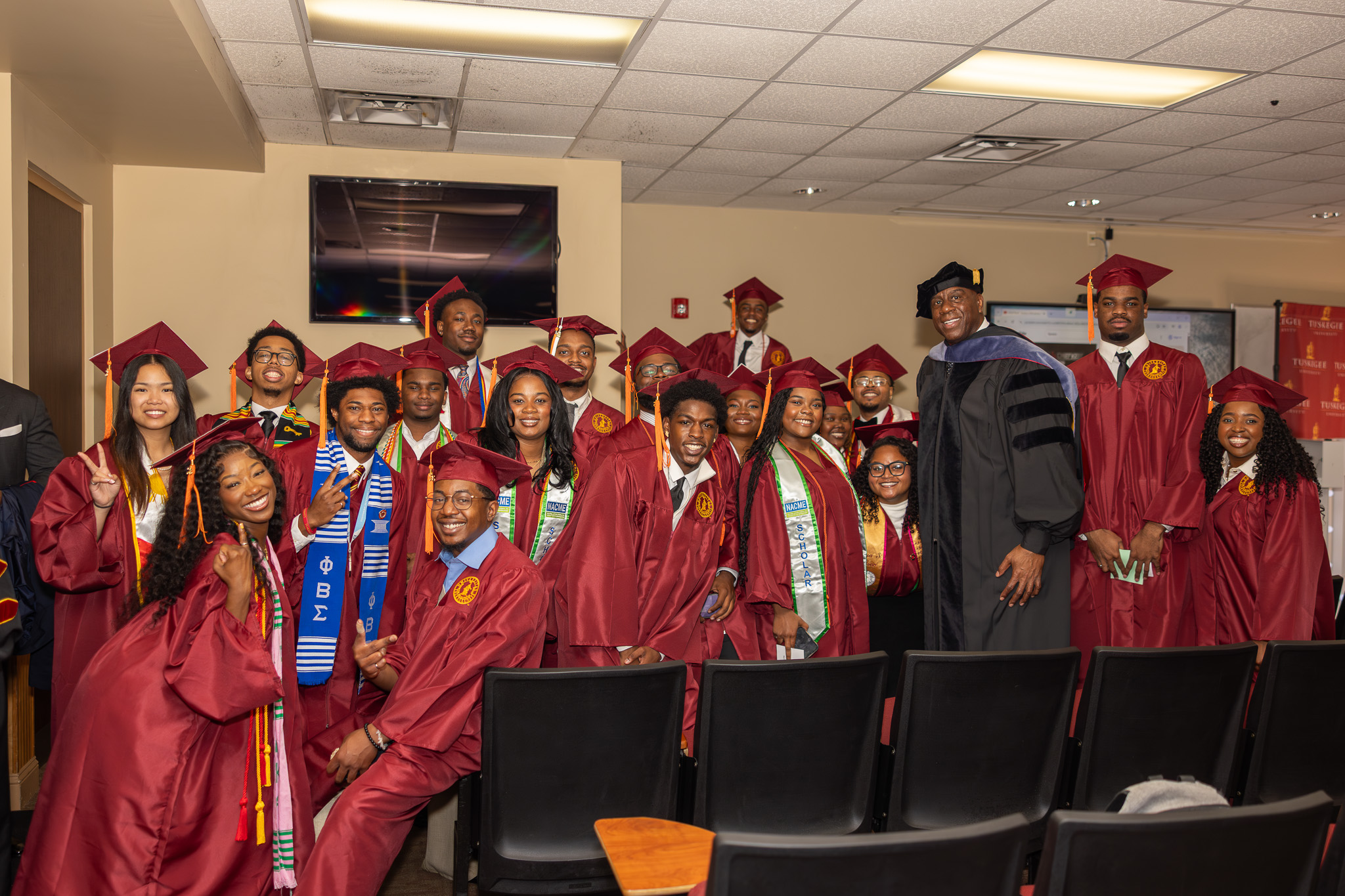
Earvin “Magic” Johnson shared his iconic joy and wisdom as Commencement Speaker

When more than 300 Tuskegee University undergraduates walked across the stage and into their futures last Saturday, 40 percent were walking into full-time roles to begin meaningful careers in areas of their choice. Combining those fully employed, accepted into graduate schools or pursuing careers as military officers, that number swells to over 70 percent.
Tuskegee’s Renaissance Era is focused on producing this very specific outcome for every Tuskegee graduate, offering majors that, according to the U.S. Bureau of Labor Statistics will prepare Tuskegee graduates for some of the country’s most in-demand professions – including nursing and allied health, tech related to cybersecurity and data science, engineering and construction, elementary through high school education and social work.
“We make a promise to parents and loved ones when they entrust their children with us – and we work tirelessly every day for those students who are here to equip them with the skills and competencies necessary to begin careers that will measurably increase their social and economic mobility,” said Dr. Mark A. Brown, president and CEO. “And while it is their choice, we strive to ensure every student's choice is informed by meaningful internships and the economic realities of different career choices for this region and throughout the country. Our students are better able to build sustainable careers – pursuing the life work they choose for themselves – because they and their families wisely invested in a college degree from Tuskegee University.”

Last year, U.S. News and World Report backed that up, ranking
Tuskegee University No. 1 in Social Mobility among regional universities in the south. And in its recently redesigned classification system, the American Council on Education and the Carnegie Foundation for the Advancement of Teaching has introduced a new category that pointedly reflects how the education provided by institutions of higher education directly correlates to the economic success rates of those who earned degrees, the Opportunity College designation – Tuskegee University was granted this designation in 2025. For parents, families, and the graduates who have earned their degrees at Tuskegee University, these proof points are life-changing.
Tuskegee University is ready to talk Return on Investment.
Tuskegee graduates’ ability to step into the workforce is due in large part to the university’s elevated requirements that, beyond classroom excellence, students must get prepared for these roles, before they graduate, to demonstrate value to future employers. They are sharpening workplace-based research, critical thinking and soft skills required to compete globally for in-demand jobs: more than 75 percent of graduates completed at least one internship, most completing two or more:
 76.09% completed internships
- 56.83% completed clinicals, practicums, or student teaching
- 26.81% participated in directed research
- 20.29% studied abroad or away
Ten students maintained 4.0 GPAs the entirety of their Tuskegee University undergraduate matriculation. Nearly 55 percent of graduates reached cum laude, magna cum laude or summa cum laude.
Twenty of the Class of 2026 graduates are now U.S. military officers, commissioned the day before commencement – by the only ROTC program at an HBCU where students can train in all five branches of the U.S. armed forces – deploying to bases around the world, pressed into leadership as the country is at war.
“The Tuskegee mission dates back to a core principle that founders always intended for the institution. It insisted that the purpose of an education was not for education’s sake alone,” said Dr. Brown. “It was meant to develop the ’head, hand and heart’ of a person, shaping them into both scholars and servant leaders who master valuable skills in order to master their own fate in the workforce and the world, and then make that enriched version of life possible for others.”

It is very clear that the through line from that vision to today’s workplace landscape is sharply drawn in Tuskegee’s Renaissance Era, and paying practical dividends into students’ futures.
Honoring the legacy of the Tuskegee Airmen, the university introduced a new aviation science degree program in the College of Engineering in January of 2025. At the May 9 ceremony, 15 students graduated with their private pilots’ licenses and 11 are already instrument rated, and well on their way to completing all four FAA requirements to begin careers as commercial, cargo or military pilots.
Seventy-two students graduated from Tuskegee’s School of Nursing and Allied Health – professions that are growing increasingly understaffed, particularly in rural communities like those in much of Alabama.

The Alabama Department of Labor confirms that job postings for nursing positions have surged, dominating the landscape of employment opportunities throughout November. The state is grappling with a critical shortage of qualified nursing professionals, leading industry experts to warn of a potential shortfall of as many as 14,000 nurses by the year 2027.
According to the Bureau of Labor Statistics, nearly 190,000 openings for registered nurses are projected across the country through 2034, at a rate of growth 5 percent faster than all other occupations.
All 15 of Tuskegee’s newly minted nurses have either passed their registered nurses (RN) licensure exam and are already working as RNs, or have job offers while they prepare for the exam. Twenty-seven of the allied health graduates are moving straight to graduate school this summer or fall, 16 are working and the rest are making their plans in a field that continues to outpace nearly all others, particularly in more specialized functions and those requiring a master’s degree and other certifications.
“What happens here matters, not only to Tuskegee, but to this nation and the future it is building in real time,” said Dr. Brown.

Tuskegee is producing a workforce ready for the shifting global landscape, including recent College of Business and Information Science (CBIS) graduates who have earned degrees in finance, supply chain management and Tuskegee’s growing artificial intelligence and machine learning, cybersecurity, and advanced computing systems curriculums. Nearly 89 percent of CBIS graduates turned their tassels already enrolled in graduate school or with confirmed job offers to weigh, from companies including Amazon, Pepsico, Textron and Southern Company or will be using their degrees as they grow their careers as officers in the U.S. Army and U.S. Air Force.
“These ceremonies are not symbolic,” he added. “We are sending our best and brightest into the world to be game-changers with technology that is now shaping how we heal, how we learn, how we govern, how wealth is created and distributed, and how we defend this country.”

As Earvin “Magic” Johnson delivered his commencement address, the iconic NBA legend, billionaire business leader and philanthropist reminded students that regardless of humble beginnings and unimaginable setbacks, they could, as he did, rise to extraordinary achievements if they are willing to put in more of the hard work that had brought them to this milestone. He encouraged them to pool their resources as a community to become owners of businesses, and of their own futures. And he challenged them to “bottle up these past four years, bottle up this moment” as a precious touchstone they will need to gird them against a world that, unlike the haven of Mother Tuskegee, will confront them with naysayers, obstacles and unearned penalties.
Dr. Brown agrees with Johnson that their Tuskegee education is like a secret sauce to be viewed in light of the future potency it will deliver.
“We intend to move boldly and more swiftly into the Renaissance Era,” says Dr. Brown. “The evidence is clear that a Tuskegee University education is an investment that can pay for itself many times over in the earning power it can unleash for graduates, and the social mobility and quality of life that grows from there.”
© 2026 Tuskegee University