 Contact: Crystal Drake, Office of Strategic Communications
At the 2026 STEM Achievers Student Showcase, more than 60 Alabama middle school students presented innovative research projects and technology-driven solutions designed to address some of society’s most pressing challenges on campus at Tuskegee last week.
The showcase marked the culmination of a two-week STEM immersion experience that brought together 61 sixth-, seventh-, and eighth-grade students from surrounding communities, including Macon, Lee and Montgomery counties to a no-cost summer program.
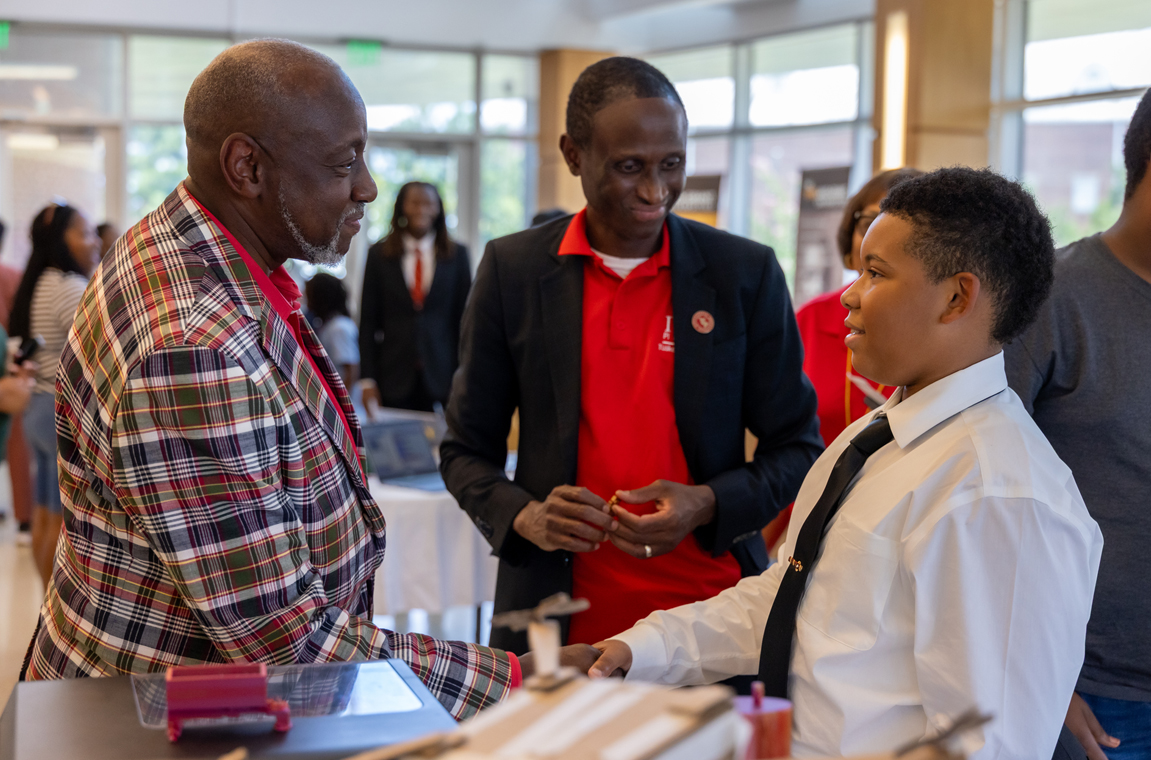
Dr. Mark A. Brown, president and CEO, spent time with students who confidently demonstrated their capstone projects at stations in the atrium and in classrooms of Henderson Hall, home of Tuskegee’s College of Agriculture, Environment and Nutrition Sciences (CAENS).
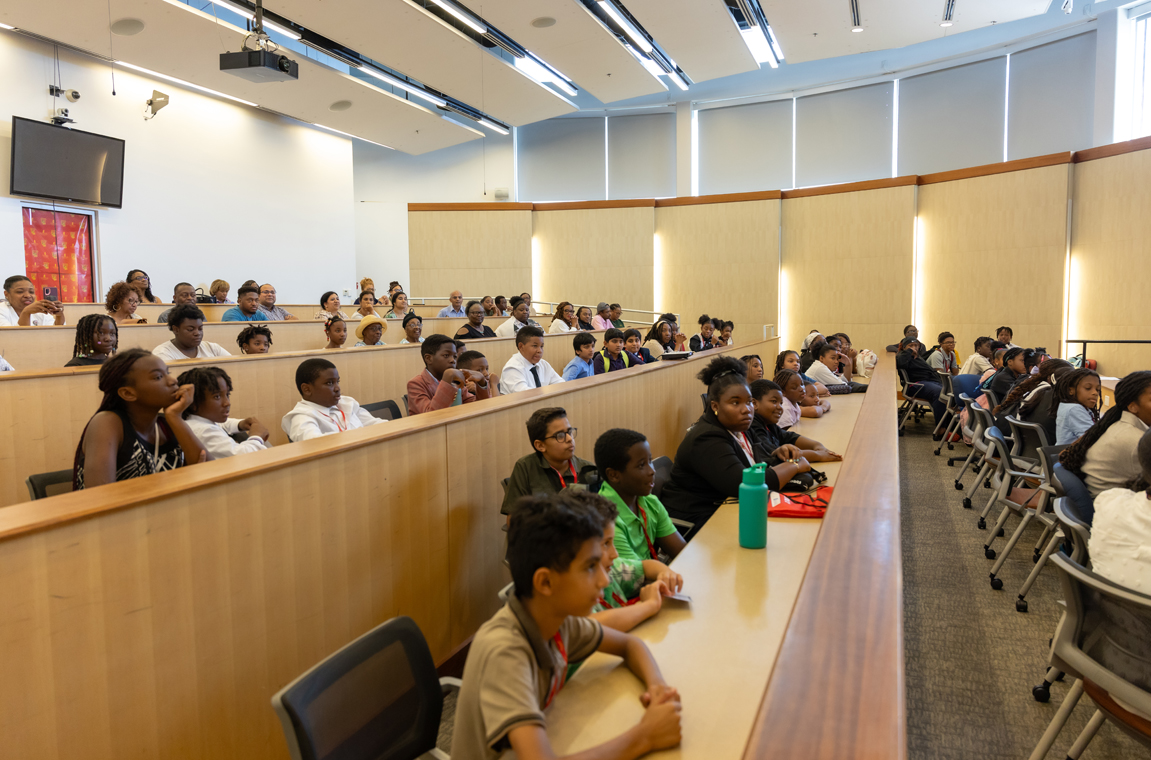 “From our very beginning, Tuskegee University has focused on harnessing science, the most modern technology, innovative minds and a commitment to use all of that talent to improve the human condition,” he said to the students and their proud relatives gathered in the CAENS auditorium. “And I am excited to see these young scholars are doing just that.”
The event reflects the university’s continued commitment to expanding science-based research and innovation during Tuskegee’s Renaissance Era. As Tuskegee accelerates its trajectory toward Carnegie R2 status, the university is simultaneously investing in the next generation of scientists, engineers, technologists, and entrepreneurs.
The program is part of a collaborative initiative aimed at addressing barriers to digital inclusion and equipping underserved youth with critical digital skills. Designed specifically for students from under-resourced middle schools, STEM Achievers combines academic enrichment with career exploration and personal development while introducing participants to emerging technologies and innovation-focused problem solving.
By combining hands-on STEM experiences with mentorship and exposure to emerging technologies, the STEM Achievers Program connected classroom learning with practical application, empowering students to see themselves as innovators, researchers, and future leaders. Throughout the experience, students were presented with a new “mission for the day,” encouraging them to work collaboratively and creatively while exploring solutions connected to global challenges.
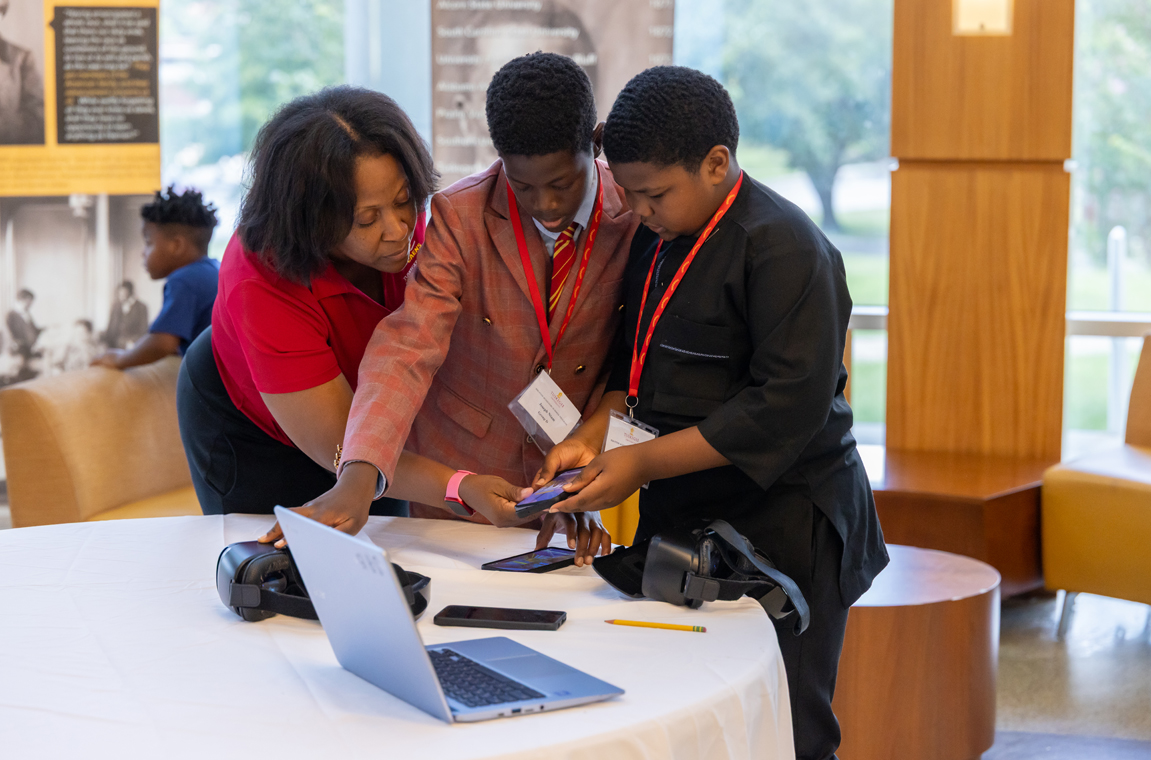 The showcase on Friday included greetings from Dr. Thierno Thiam, Provost and Senior Vice President for Academic Affairs, who challenged students to identify the program’s five primary goals. Hands immediately shot into the air as students confidently recited them: ending poverty, ending food insecurity, creating affordable and clean energy, promoting economic mobility through effective career pathways, and increasing gender equity in STEM careers.
“The entire world should align with these goals,” said Dr. Brown. “The world should no longer endure poverty or operate without a sustainable food supply and you are pondering the solutions that will change that for Alabama, this country and the world.”
Student presentations showcased both creativity and a deep understanding of STEM applications.
Isaac Browning, a seventh-grade student at George Walton Academy in Monroe, Georgia, partnered with Algasir Hago, an eighth-grader at Auburn Junior High School, to develop a 3D-printing platform designed to address practical challenges through innovative manufacturing technology.
“You can see here how to speed up or slow down the production,” Browning said, demonstrating on a laptop the production of Tuskegee University branded binding clips. His Tuskegee school spirit is homegrown – his father, Orric Browning, graduated with a Chemical Engineering degree in 1998 and his grandmother, Belinda Patrick, is an Assistant Cashier in the Office of the Bursar.
Focusing on climate action, Emery Burnett, an eighth-grader at Booker T. Washington High School, which has seventh to 12th-grade students, and Jaleya Robinson, an eighth-grader at Auburn Junior High School, presented a solution aimed at environmental preservation.
“Keystone species are dying, which will eventually impact all other species, including humans,” Burnett explained. “Our solution is a water-level monitor that will prevent impacts like dehydration.”
Another standout project came from Carter Fleming, an eighth-grade student from Floyd Middle School in Montgomery, who developed an autonomous plant hydration system designed to improve soil irrigation management. “This technology would automate the watering process so humans can focus on higher-level tasks that machines can’t do,” he said.
© 2026 Tuskegee University