Contact: Crystal Drake, Office of Strategic Communications
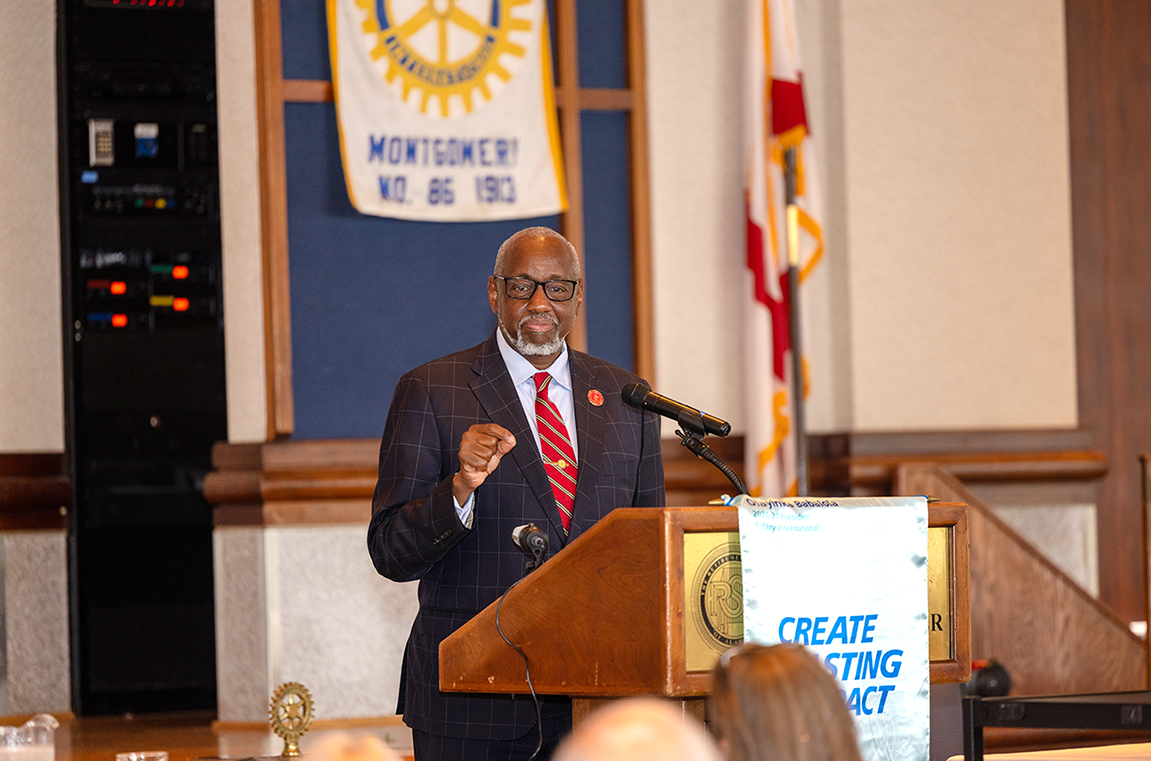
Speaking to a room of Montgomery’s most active civic and business leaders, Dr. Mark A. Brown, president and CEO, outlined Tuskegee’s economic impact, historic growth, and transformational workforce pipeline during the Montgomery Rotary Club's monthly meeting on Aug. 24.
Montgomery Rotary Club President Henry Davis III, who also serves on the Tuskegee University Board of Trustees, welcomed Dr. Brown. He brought the meeting to order with a gavel more than 80 years old crafted from the wood of tree which had stood on land in Tuskegee where Paul P. Harris, the founder of Rotary International, spent winters during his final years.
“We are in our Renaissance Era at Tuskegee University, focused on people, places and prosperity all in service to expanding opportunity, increasing enrollment, and strengthening support for our students,” said Dr. Brown. “And, in doing so, ensuring successful outcomes which are rooted in the same principles we were founded on 145 years ago - that a Tuskegee education trains the head, hand and heart of students to go out and change the world.”
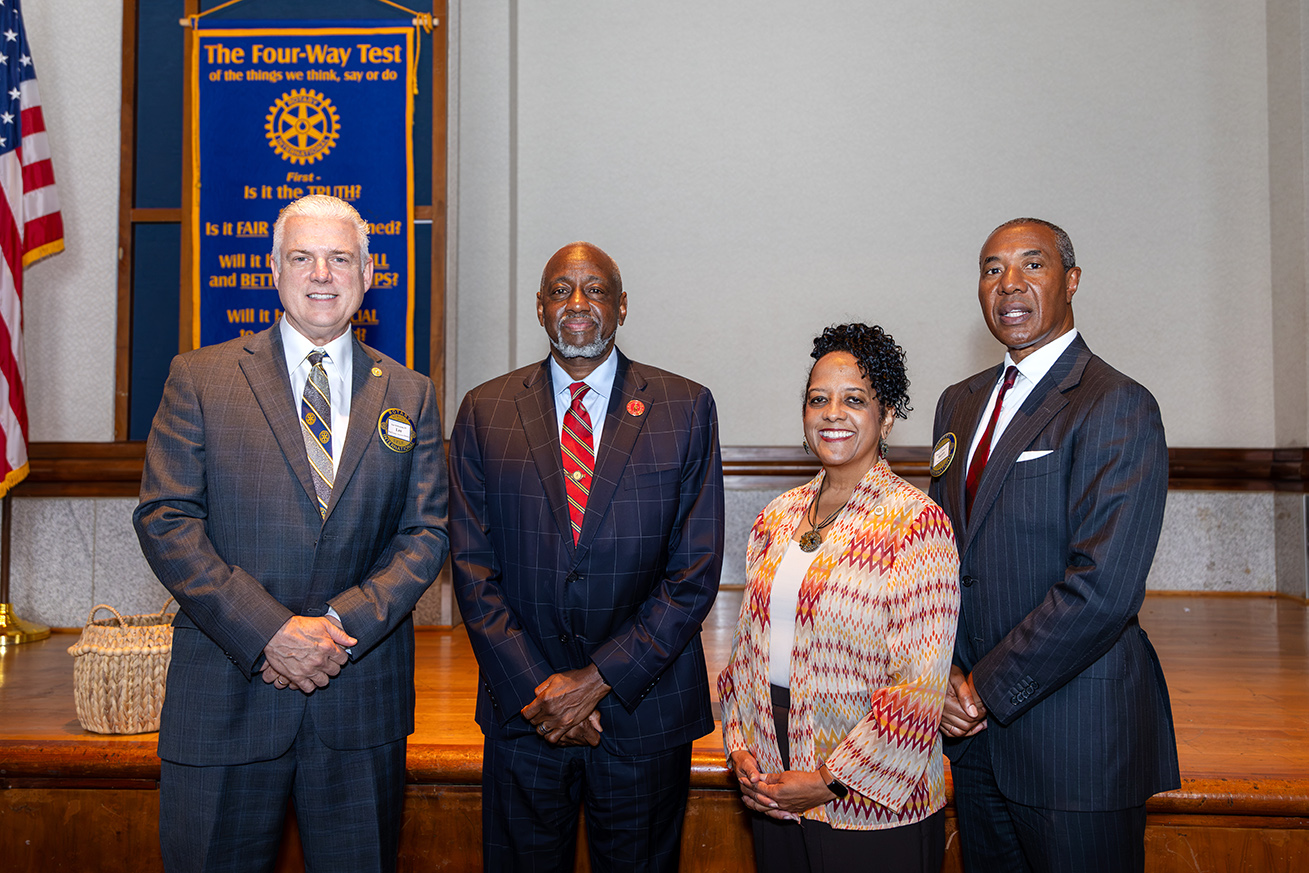
“We believe Tuskegee is a national treasure, and our standards will not change. I don’t hesitate to say that our students are different, and they are ready to continue delivering on the Tuskegee legacy right here in Alabama and across the nation,” said Dr. Brown.
He was very clear about just how ready Tuskegee students are, challenging members to let him know specific roles they are finding difficult to fill. He assured them that Tuskegee’s academic rigor, requirements for real-world experience before graduation and emphasis and professional development make Tuskegee graduates the problem-solvers employers need.
“I am willing to bet, we are training for that role at Tuskegee,” he said. “And if we aren’t, we will be soon because our curriculum framework is, and always has been, built around the premise that Tuskegee students are preparing for the real economy, with skills the world needs.”
During the Q & A portion of the event, he was asked his thoughts on the debate around the value of a college education and institutions grappling with decline.

“This fall we reached the highest undergraduate enrollment in recent history, more than 3600 students, so that isn’t our story. And that is because of the value proposition we offer to students, and their parents. When our students cross the graduation stage, they are prepared to compete and win in the global economy,” he said, citing a Bureau of Labor and Statistics data point that college graduates can anticipate 1.2 million dollars in increased lifetime income compared to peers who do not have a degree. “In May of this year, the Class of 2026 graduated with 70 percent of students already employed in careers of their choice, accepted to graduate school or beginning careers as military officers commissioned through Tuskegee’s ROTC.”
Dr. Brown also made clear Tuskegee University's significant economic impact on Alabama. He explained the many ways it is an exponentially significant return on the investment made by the Alabama Legislature in 1881 when that body appropriated 100 acres and $2000 to establish the school. Tuskegee now delivers more than $300 million in economic impact annually to the state from a campus on more than 5000 acres of developed land. Approximately $70 million each year is distributed through salaries, wages, and benefits, supporting spending across local businesses throughout five Alabama counties. In addition, the institution spends approximately $80 million annually with vendors across the state, much of which remains within Alabama's economy.

"Tuskegee University is the largest employer in Macon County, the largest consumer for the Utilities Board of Tuskegee, and the largest taxpayer in the City of Tuskegee," Brown said. "When people ask whether Tuskegee University matters to Alabama, I give them one number. Take us out of this state and you take nearly a third of a billion dollars a year out with us. Our viability is not a Macon County question. It is an Alabama question."
In closing, Brown invited Rotary members to become direct influencers in Tuskegee’s success.
"If your organization touches health care in this region, I am asking for one seat. One," Brown said in an appeal for additional nursing apprenticeship placements like the one recently launched with Baptist Health Systems and Tuskegee’s School of Nursing and Allied Health.
“For the past two years, 100 percent of our nursing students have passed their licensing exam on the first try. Tuskegee students are ready to address the nursing shortage in Alabama, and across the country,” he said.
He also encouraged the Rotary Club to establish a Montgomery Renaissance Scholarship for local students attending Tuskegee University, develop paid internships for talented students studying engineering, agriculture, aviation and cybersecurity, and he invited members to visit the campus and learn firsthand about ongoing developments.
"If Rotary believes in investments that are beneficial to all concerned, then Tuskegee University is one of Alabama's best investments,” said Dr. Brown. And I intend to do everything I can to ensure it remains a viable economic engine for this state and a pathway to social and economic mobility for generations to come."
© 2026 Tuskegee University