Contact: Crystal Drake, Office of Strategic Communications
Team’s invention will allow farmer’s a custom, scalable solution to a variety of tasks
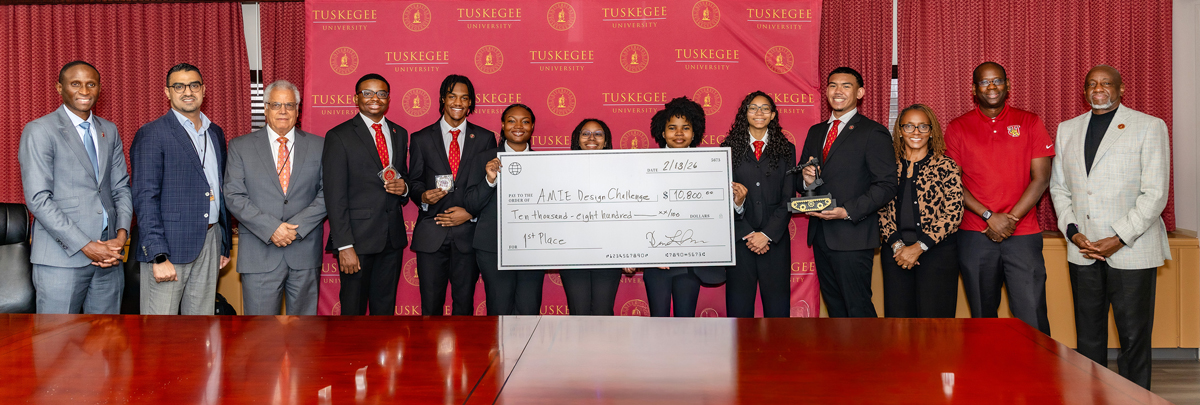
A team of students from the College of Engineering won first place at the ninth annual Advancing Minorities Interest in Engineering (AMIE) Design Challenge at the 2026 BEYA STEM Conference in Baltimore, Maryland – besting 14 other teams at the highly competitive event.
The AMIE Design Challenge is a flagship competition that invites student teams from each of the ABET-accredited HBCU Schools of Engineering to develop, implement, and present their solutions to specified design problems. The submissions are evaluated by judges from industry and governmental experts.
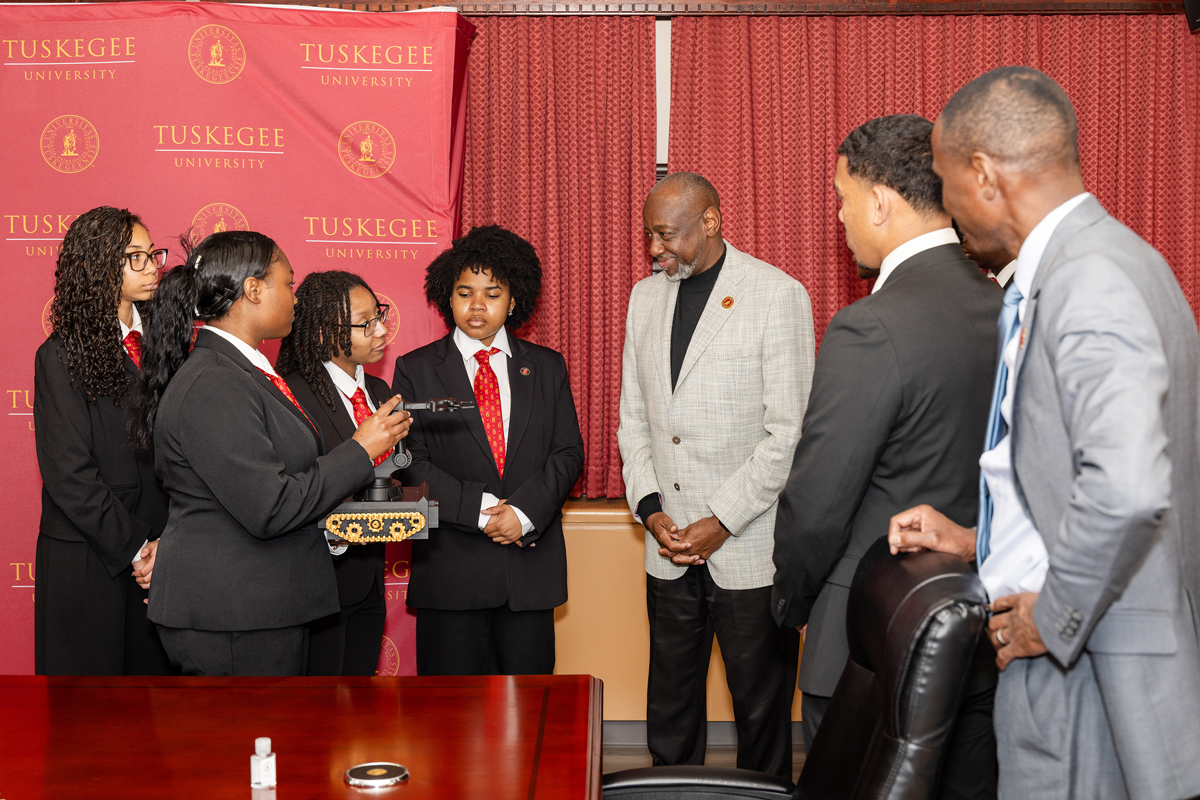
The seven-member Tuskegee team met with Dr. Mark A. Brown, President and CEO, to share the great news.
“This is a genuine reflection of our Renaissance Era – a Washington/Carver kind of solution to a challenge facing farmers today. At Tuskegee we do things that matter to everyday people, that solve real problems and offer practical solutions – and that’s what you’ve done here,” said Dr. Brown, marveling at the ingenuity of the team’s project – a prototype of which they brought to the meeting. “Once again, we are solving the world’s most complex problems!”
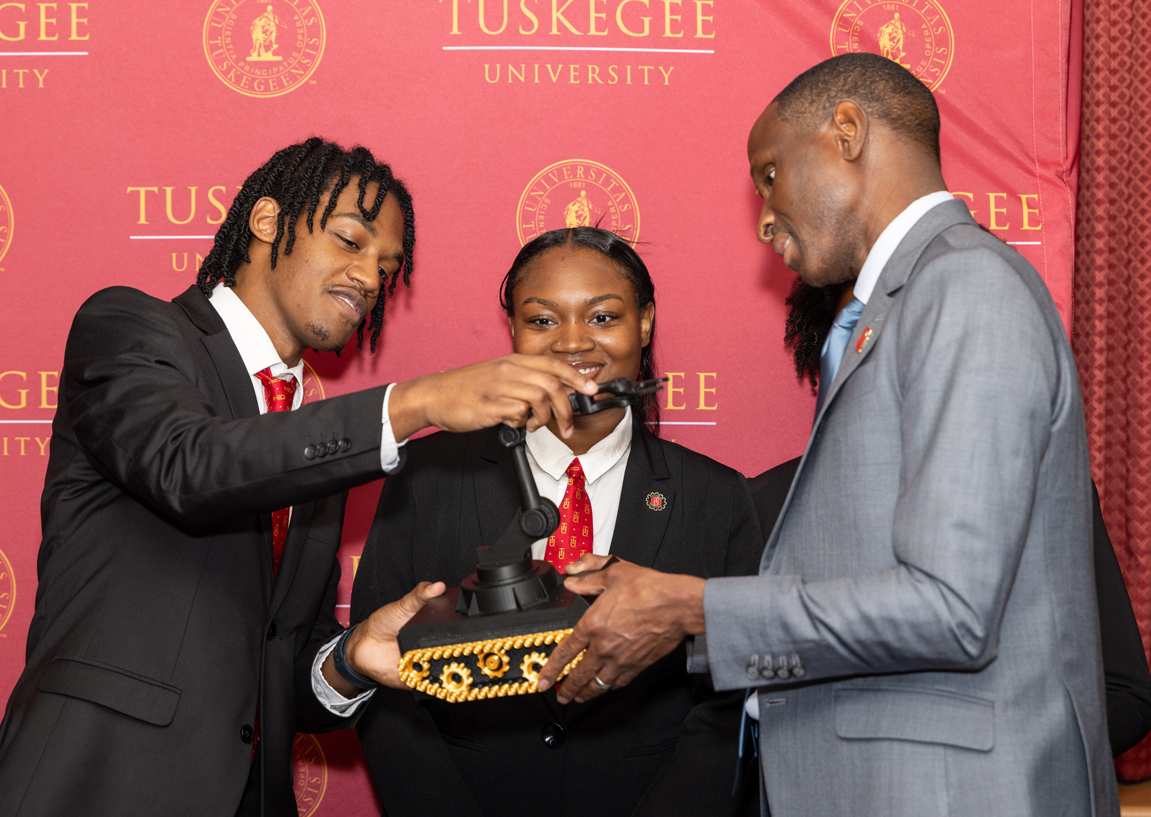
The Tuskegee-winning design, Farm Guard, is a modular agricultural robotic system that integrates robotics, Artificial Intelligence (AI), computer vision, and autonomous decision-making to help farmers reduce crop loss, detect pests, and reduce labor requirements. By combining AI-driven perception with robotic actuation, Farm Guard supports early detection and mitigation of threats to crops to improve efficiency and yield. This win includes a $10,800 prize for the College of Engineering to support outreach and retention activities.
This year, the organizers tasked student teams with proposing solutions for a general design problem: “How might we design innovative, human-centered solutions that leverage emerging technologies such as AI, cybersecurity, data science, VR, autonomous systems, advanced energy systems, and sustainability practices to address complex societal and environmental challenges, overcome barriers to industry and government progress, or create new opportunities by disrupting existing markets?”
Kirsten Hill, a junior Electrical Engineering major shared that a provisionalpatent application was submitted to AMIE for further processing and explained how the machine can fit a wide variety of needs, price points and functions.
“What makes this robot so unique is that it is modular, it can adapt specifically to what farmers need. Before there were no options for farmers but now there is one – from expensive to less costly, from complex to simple, the robotic brain can adapt.”
The Tuskegee Team:
- Kristin Hill – Junior, Electrical Engineering (Jackson, Mississippi)
- Diara Lawrence – Junior, Mechanical Engineering (Vestavia Hills, Alabama)
- Everett Mason – Junior, Mechanical Engineering (Lorman, Mississippi)
- Kendall Powe – Junior, Electrical Engineering (Mableton, Georgia)
- Madison Harper – Junior, Computer Engineering (Itta Bena, Mississippi)
- Kieon Miller – Sophomore, Mechanical Engineering (South San Francisco, California)
- Hilton Gray – Freshman Mechanical Engineering (Houston, Texas)
Faculty advisors Dr. Moath Alsafasfeh, Assistant Professor of Electrical and Computer Engineering, and Dr. Mandoye Ndoye, Professor of Electrical and Computer Engineering joined the celebration along with Dr. Heshmat Aglan, Dean of the College of Engineering and Toya Dean, Coordinator of Student Activities, College of Engineering.
“Our students worked diligently as a team, as critical-thinkers and problem solvers with a passion for making highly technical functionality a truly disruptive option for farmers and agriculturalists,” said Dr. Aglan. “It’s the Tuskegee Way.”
© 2026 Tuskegee University