Contact: Crystal Drake, Office of Strategic Communications
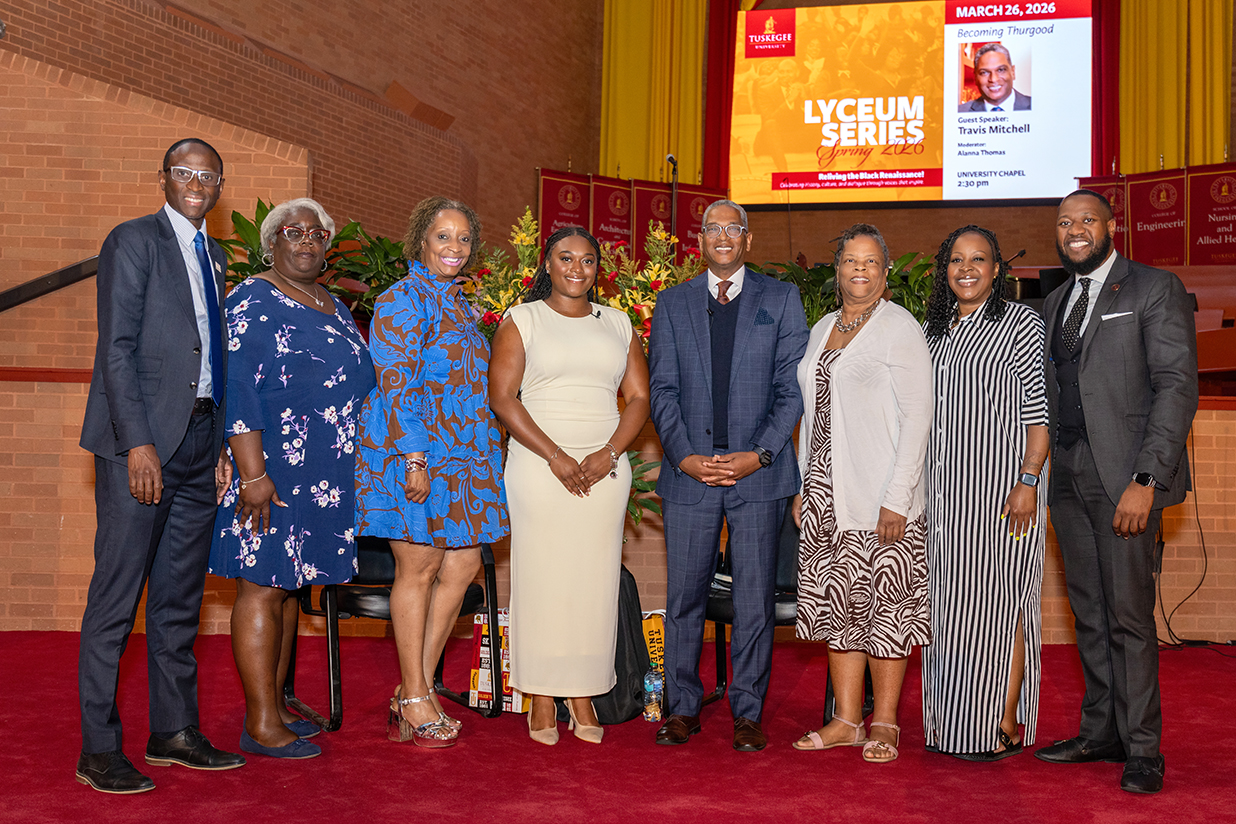
Tuskegee University’s Lyceum Series, Reliving the Black Renaissance: Celebrating History, Culture and Dialogue through Voices that Inspire, continues to reveal the through-lines that connect history to now and to what’s next. The university recently hosted the second in the new series of intellectual forums, welcoming Travis Mitchell, Senior Vice President and Chief Content Officer at Maryland Public Television, to discuss Becoming Thurgood: America’s Social Architect, a film he co-executive produced.
“It is vital that this generation becomes fully aware of those giants on whose shoulders they stand,” said Dr. Thierno Thiam, Provost and Senior Vice President for Academic Affairs. “Tuskegee University’s Renaissance era is an important opportunity not simply to remember what has come before but to re-examine and reimagine what those unwavering principles mean for us today. Becoming Thurgood is a masterclass in taking a fresh look to apply history to the world our students must navigate now.”
The film chronicles Justice Marshall’s journey from his birth in Baltimore, Maryland, in 1908 through his education at HBCUs Lincoln University and Howard University School of Law, and his groundbreaking career as a lawyer championing civil rights and dismantling school segregation. Marshall won 29 of the 32 cases he argued before the U.S. Supreme Court, including the landmark Brown v. Board of Education in 1954, invalidating the separate-but-equal doctrine and ending racial segregation in public schools. In 1967, Marshall became the first African American appointed to serve on the U.S. Supreme Court.
Moderated by senior Alanna Thomas, a pre-law political science major from Atlanta, Georgia, the conversation covered the genesis of the project and Mitchell’s passion for encouraging students to remain fully engaged in modern-day interpretations of cultural heroes.
“What we thought was critically important was that we covered Marshall from a vantage point that modern-day students could feel connected to and appreciate,” said Mitchell, a five-time Emmy Award winner and an HBCU graduate himself, having earned an undergraduate degree in broadcast journalism from Morgan State University.
Mitchell noted that while he grew up with a solid understanding of Marshall’s weight as a legal andcivil-rights giant, the film’s team realized that many millennials and Gen Zers did not know him well—what his voice sounded like or what he looked like when he was young—so they started from there as they considered how to humanize the icon.
“This is also the first film that features his family—we get the backstory of Thurgood Marshall the man, not just the legend,” said Mitchell. “It is critical for students to relate to these iconic figures beyond history books and to know they breathed, ate, slept and struggled with the human condition just like you, and if they could do it, so can you.”
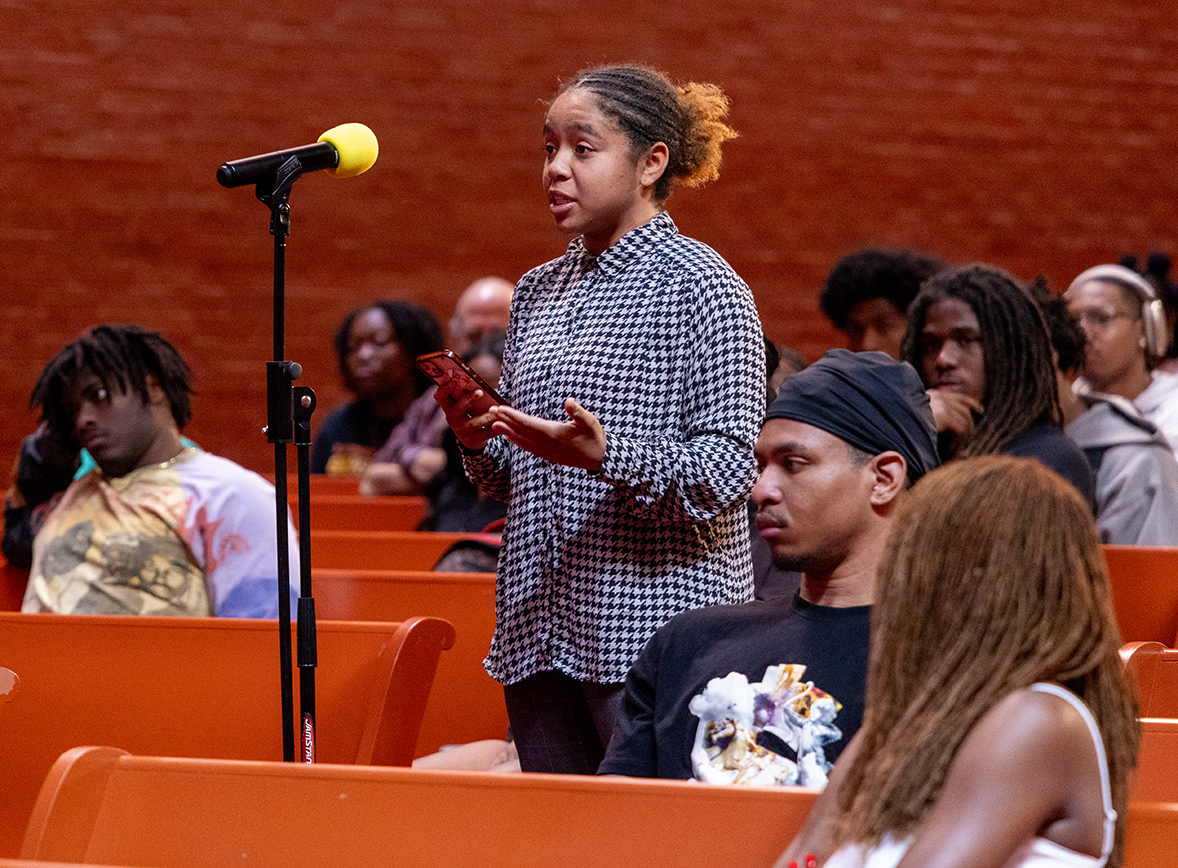
Mitchell also discussed a part of Marshall’s history that he wished could have been explored more deeply in the film, particularly the tight cultural network that protected his life as he traveled and litigated in the South before his elevation to the Supreme Court.
“The resistance and hostility were real, and waiting for him,” said Mitchell, noting the quiet cover organizations like the Freemasons and Black Greek fraternities provided him, including shelter and transportation.
Mitchell shared that he would like to see the life of Booker T. Washington celebrated in a similar film.
“Mr. Washington is a hero of mine. I studied his work closely. I am convinced that he is misunderstood in the annals of history,” Mitchell said. “He was playing chess when other people were playing checkers.”
Becoming Thurgood includes an image of the Booker T. Washington monument, and Mitchell explained the intent was to draw parallels between the arc of Marshall’s awakening and growth in understanding and the literal unveiling depicted in the statue.
“Tuskegee University represents the awakening of the minds of students to reach their fullest potential. We wanted to show that in Thurgood’s trajectory.”
Mitchell challenged the audience to see themselves in Marshall’s work, lamenting that he believes many of the cases Marshall won based solely on the strength of the legal arguments could not be won in today’s political environment.
“We are in a place in our nation; we have to ask the question—if not now, then when; if not us, then who?”
Tuskegee will continue this thought-provoking series in April. On April 23, Student Trustee Carrington Thompson will moderate a conversation “Leading in Challenging Times,” with three HBCU presidents, including Dr. Mark A. Brown, President and CEO, Morgan State President and Tuskegee alum, Dr. David Wilson, and Benedict College President, Dr. Roslyn Clark Artis.
© 2026 Tuskegee University