
Contact: Crystal Drake, Office of Strategic Communications
As the anniversary of Booker T. Washington’s birth approaches, the Alabama Legislature formally recognized April 5 as Booker T. Washington Day, pausing to reflect on one of the most enduring partnerships in the state’s history.
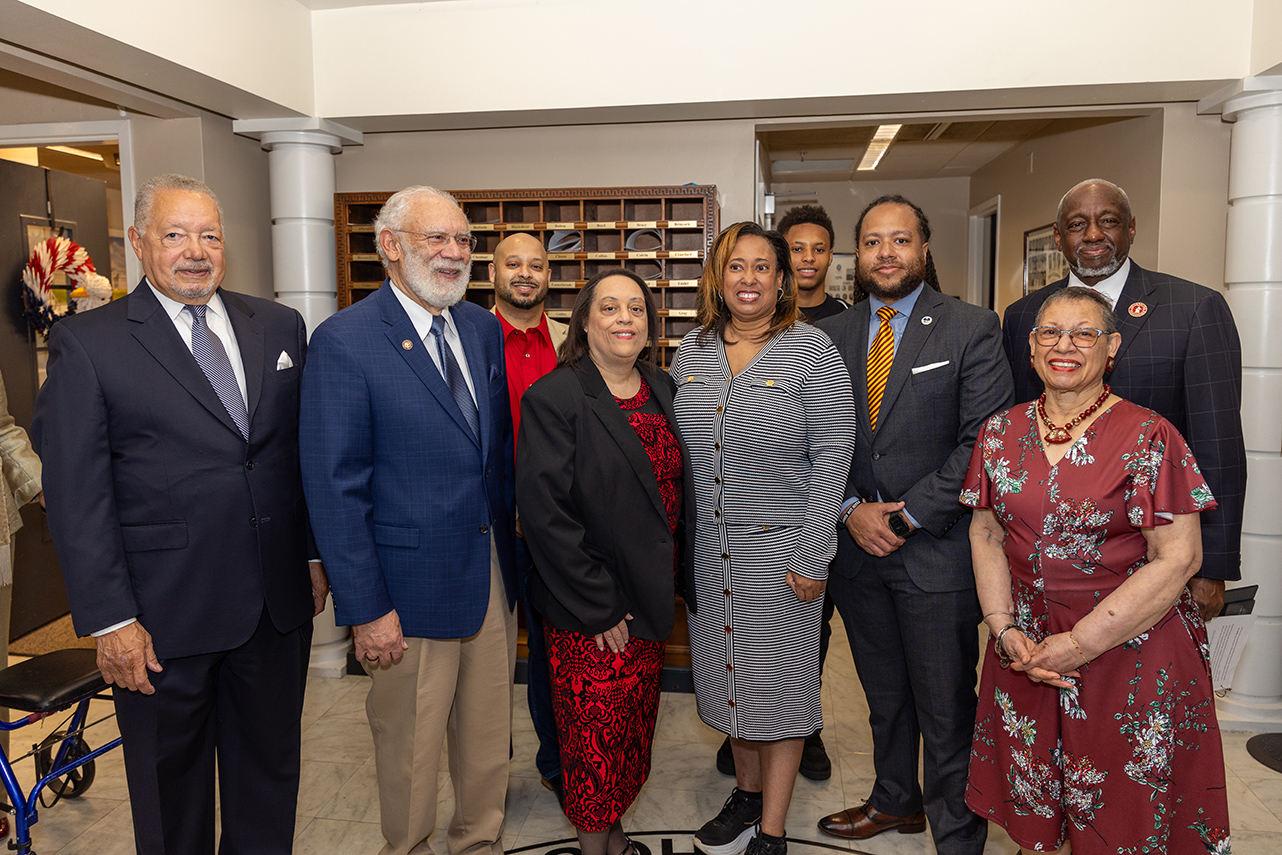
The occasion was marked by a rare and consequential moment: a sitting president of Tuskegee University addressing the full assembly of the Alabama Legislature. Dr. Mark A. Brown, president and chief executive officer, joined descendants of Booker T. Washington at the Alabama State Capitol on Tuesday in Montgomery for the observance.

The resolution was introduced by Alabama State Representative Pebblin Warren ’74, a Tuskegee University trustee, underscoring both institutional continuity and shared responsibility between the state and the university.
In his remarks from the House floor, Dr. Brown, the first Tuskegee graduate to serve as president of the university, placed the moment within a broader historical frame, noting that Tuskegee’s founding was neither symbolic nor accidental, but the result of a deliberate act of public investment.
Dr. Brown noted that what is sometimes lost amid the well-earned reverence afforded to Washington's personal achievements, is that his vision for Tuskegee was not realized in isolation – it was built through stewardship, collaboration, and sustained commitment, the hallmarks of any meaningful public investment.
In 1881, the same governing body now honoring Booker T. Washington appropriated 100 acres of land and $2,000 to establish what would become Tuskegee Institute. Dr. Brown reminded legislators that this decision represented more than an appropriation; it reflected a partnership grounded in shared expectations of benefit, accountability, and long-term return.

“One hundred and forty-four years later, the return on this body’s investment is clear,” said Dr. Brown.
The original 100 acres have grown to more than 5,000 acres, making Tuskegee University one of the most significant land-holding institutions in the state of Alabama. What began with a $2,000 appropriation has matured into a powerful economic driver. Today, Tuskegee University generates an estimated $237.1 million in annual economic impact and supports more than 3,000 jobs, reinforcing its role as a major economic engine for the region and for the state.
Dr. Brown emphasized that this growth reflects Booker T. Washington’s enduring philosophy: that education must serve both individual advancement and the broader public good. Washington’s work reshaped Alabama first, then influenced the nation and the world. Tuskegee University, he noted, continues in that tradition today.
“The legacy of this enduring icon lives on,” Dr. Brown said, “not merely for the sake of education, but to improve the human condition. He understood that education, at its best, must develop skill, character, and intellect together. The Hand, Head, and Heart philosophy remains relevant today.”
As part of his address, Dr. Brown highlighted several examples of the contemporary impact of that philosophy, tangible evidence of long-term returns on the investment.
The institution remains one of the nation’s leading producers of engineers in aerospace, electrical, mechanical, and chemical sciences, as well as aviation. It has reestablished its Aviation Science program at historic Moton Field, a site that helped reshape American aviation history during World War II. Tuskegee is home to the only school of veterinary medicine at a historically Black college or university and houses a genomics center conducting groundbreaking research focused on prostate, breast, and cervical cancer. The university is also designated by the U.S. Congress as a National Historic Site, a distinction held by no other university in the country.
Dr. Brown thanked the Legislature for not only honoring Booker T. Washington, but for continuing to support education through policy and investment.
“Through your continued support of education—including in your most recent budget—you affirm that Alabama still believes in the power of learning, work, and community,” said Dr. Brown.
Dr. Brown elevated the day to more than the commemoration of a great man. His address from the storied Capitol floor served as a powerful report on stewardship: a reminder that the seed planted by the State of Alabama in 1881 has yielded a return that continues to grow generation after generation.
© 2026 Tuskegee University