Walk-ins are welcomed --- Groups of 20+ should schedule an appointment in advance.
TO SCHEDULE AN APPOINTMENT:
Email: legacymuseum@tuskegee.edu | Phone: 334-724-4485 OPERATING HOURS: 10:00 a.m. - 4:00 p.m. Monday - Friday (Closed during official University holidays.)
Review the Tuskegee University Academic Calendar for official University holidays. The LEGACY MUSEUM operates under the auspices of Tuskegee University Library Services.
LOCATION (Entrance to Campus): 1200 W. Montgomery Rd., Tuskegee, AL 36088 CLICK HERE FOR DIRECTIONS.
Please follow all campus security policies and visit the Public Safety Office at 1103 W. Montgomery Rd. Tuskegee, AL 36088 before entering the campus. For the most updated security information please see the notification at the top of this page or visit the "Police-TU" page under the resources tab.
Thank you for your generosity.
We do not charge admission fees but a suggested donation of $5 per visitor is greatly appreciated.
To donate to the museum using the University portal, choose the 'Other' designation, and type 'Legacy Museum' in the text box.
Your donations support programming, student and community outreach, internships, exhibitions, and collections care.
The Sankofa Bird
THE SANKOFA BIRD (mythology from the Akan people of West Africa) Dahomean cloth appliqué Fon People's Republic of Benin (formerly Dahomey) - West Africa Tuskegee University Library Services The Lovette W. Harper Collection of African Art.
About the Legacy Museum
Welcome to the Legacy Museum at Tuskegee University.
The Legacy Museum is part of a consortium of Tuskegee University museums, including the National Park Service-operated Dr. George Washington Carver Museum, The Oaks (Booker T. Washington's Home), and the Tuskegee Airmen National Historic Site.
The Legacy Museum serves the campus and visitors by presenting the University’s visual arts collections and exhibiting the history of Tuskegee University about science, healthcare, and bioethics. Through the lens of bioethics, the museum examines the intersection of bioscience and art – both central to the history of Tuskegee University, the surrounding community, and the former Infantile Paralysis Unit of the John A. Andrew Memorial Hospital, which the museum occupies. Through rotating art exhibitions, permanent exhibitions on bioethics and the United States Public Health Service Study of Untreated Syphilis in the Negro Male in Macon County, Alabama from 1932 to 1972, and educational programs, the Legacy Museum staff provides diverse audiences an opportunity to engage with complex histories and their present ramifications. The Legacy Museum:
Preserves and exhibits Tuskegee University’s visual arts collections.
Preserves and exhibits Tuskegee University’s history and contributions to African American and American life, particularly its contributions to the sciences and healthcare.
Educates the public and Tuskegee University students, staff, and faculty about bioethics as an evolving field.
The second floor exhibitions highlight the University's art collections and rotate throughout the academic year.
On the third floor of the museum are two permanent exhibits:
The Patient, The Project, The Partnership: The Mass Production and Distribution of HeLa Cells at Tuskegee University
The United States Public Health Service Untreated Syphilis Study in the Negro Male, 1932-1972.
From left to right: Dr. Russell Brown, Ms. Henrietta Lacks, and Dr. James H.M. Henderson
The HeLa Cellexhibit celebrates the immortal life of Virginia-born Henrietta Lacks, a tobacco farmer and mother to five children. She suffered from an aggressive form of cervical cancer which landed her at Johns Hopkins University Hospital in Baltimore, MD. During the surgery to remove cancerous cells, her cervical cells were harvested and given to the lab for research purposes. Mrs. Lacks was not targeted for her cells, all surgical patients at the time had their cells sent to the lab without their knowledge or consent as a standard practice. Informed consent as we know it today, did not exist at that time. Her cells were discovered to possess the unique ability to grow and reproduce beyond measure outside of her body. HeLa’s growth characteristics made it the ideal alternative primate host cell source for the massive testing of Jonas Salk’s polio vaccine. Tuskegee University’s Carver Research Foundation was one of the sites selected to utilize the cells for vaccine testing, later mass-producing the cell line and distributing it to laboratories worldwide for various medical research projects from which we all benefit today. Recent lawsuits mean that her descendants are now receiving some of the financial gains realized from Mrs. Lacks' cell line and the medications and treatments developed with their usage.
The surviving men receiving the Official Apology from President William Clinton.
The United States Public Health Service Study of Untreated Syphilis in the Negro Male of Macon County, Alabama was an observational study that began in 1932 and was formally ended in 1972. Often erroneously called the Tuskegee Experiment or Syphilis Experiment, the Syphilis Study followed a total of 623 Black men (399 of which had previously contracted syphilis through sexual contact) for 40 years to see the effects of untreated syphilis on the Black body during autopsies. Medical research, a new field at the time, was marred by the racist and debunked pseudoscience of eugenics, which categorized and ranked people based on race. Scientists hypothesized that syphilis would function differently in the Black body than it did in the white body.
Treatment options in 1932 for syphilis included topical salves with mercury and bismuth at their base and an injectable medication with arsenic at its base, all of which can cause death by poisoning or render the patient sterile. The injectable medication took at least 12 injections and potentially more than 30 injections to affect a cure. Many patients did not complete the course of treatment given the large gauge of the needle and the fact that the medication burned on the way in.
Patients deeply trusted their doctors at the time, and the men were often spoken to in euphemisms about their condition, such as "bad blood," which could refer to issues as different as infection, low iron, fatigue, the flu, or syphilis. The men were also promised treatment for "bad blood", free medical care, meals, and burial insurance in exchange for their participation and the right to autopsy their bodies; all of which were very enticing during the financial uncertainty of the Great Depression. Although promised treatment, the men were not treated for syphilis during the study even once penicillin became widely available and known to be a safe and effective cure.
The study ended in 1972 following whistleblowing by USPHS employee Peter Buxtun which led to the groundbreaking article by Jean Heller, exposing the Study. Charles Pollard, a surviving participant of the Study, contacted attorney Fred Grey and together they filed a first-of-its-kind lawsuit against the federal government. That suit was won, leading to financial compensation for the survivors or their surviving families, with the bulk of the payout going to lifetime healthcare for the men, wives/widows, and their children. The public outrage and activism in the medical community led to Congressional hearings, the Belmont report, and the enshrinement into law of the Patient Bill Rights and Informed Consent. The men leave us both a right and responsibility to be active participants in our care and prevent any such future abuse.
Please try a virtual tour of the Legacy Museum!
IN 3D:
(c) Copyright Legacy Museum 2022. Cannot be used for any purpose without written permission from the Legacy Museum.
Or a video tour:
(c) Copyright Legacy Museum and Historical Vision Productions, 2020. Cannot be used for any purpose without written permission from the Legacy Museum and Historical Vision Productions.
The Legacy Museum Dioramas: Windows to History
CBS News Sunday Morning Broadcast
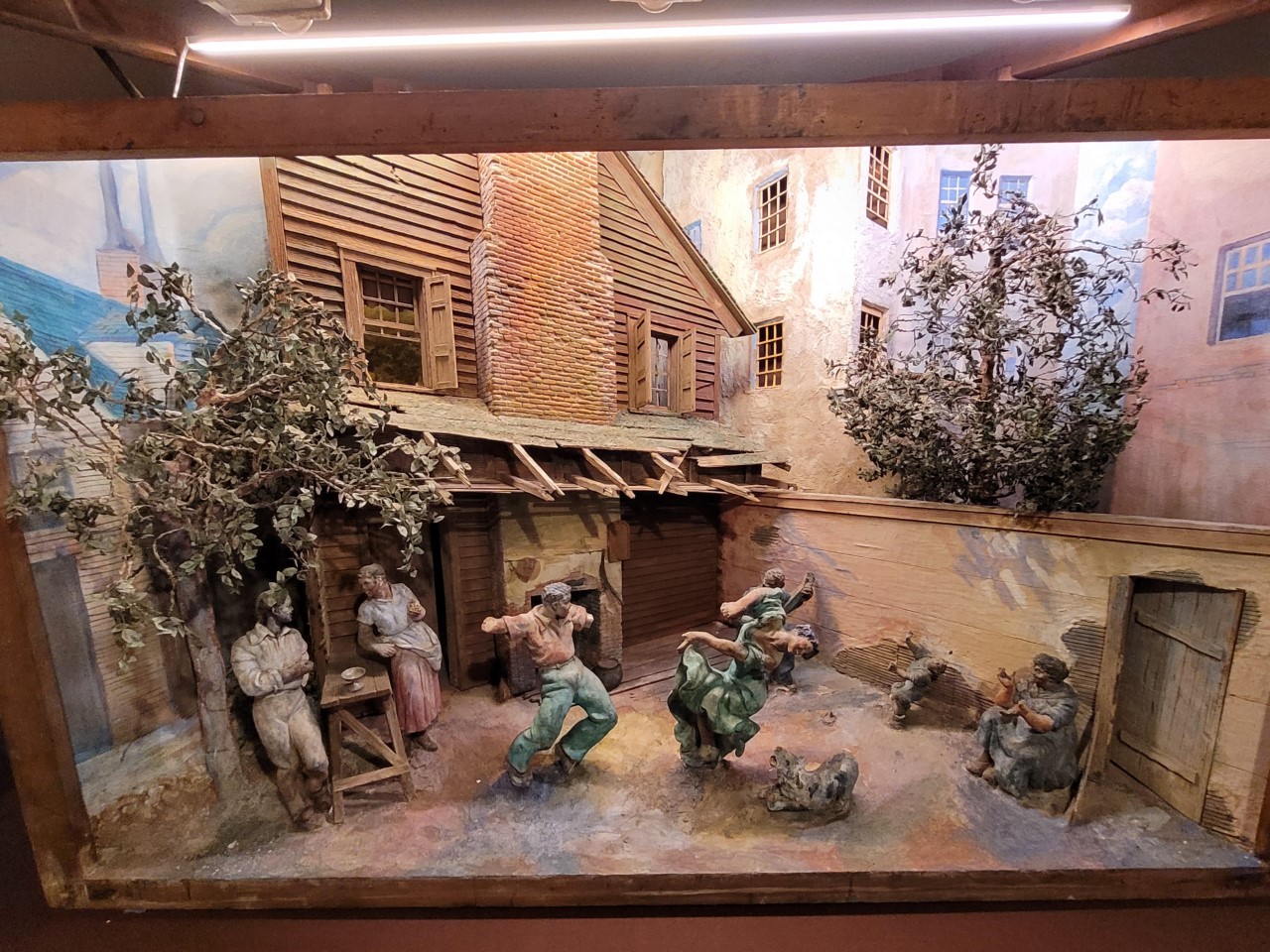
The Legacy Museum at Tuskegee University was recognized on CBS Sunday Morning on August 30, 2020, for its role in conserving extraordinary dioramas that were displayed in the 1940 Negro Exposition. These dioramas were created under Charles C. Dawson, a TU alum and well-known artist of his time.
(c) Copyright CBS Sunday Morning, 2021. Cannot be used for any purpose without written permission from the CBS Sunday Morning.
"Watch CBS Sunday Morning cover the incredible conservation of 20 The Legacy Museum, Tuskegee University dioramas from 1940, including "Reconstruction after the War" which was treated here #atSAAM two summers ago!”
U.S. Senator Chris Coons
“Proud to see the First State represented on CBS Sunday Morning! Winterthur Museum, Garden & Library and The Legacy Museum of Tuskegee University are collaborating to restore dioramas of Black American figures like the famed Harlem Hell fighters from World War 1. These dioramas—first created in 1940—were a platform for Black artists to share their work while helping promote racial understanding. Check out more information on the collaboration with the University of Delaware from Delaware’s own, Winterthur Museum.”
Rena Iversen Edminster
“Terrific segment. Thoroughly enjoyed it. Wonderful to see it's being restored & new people to learn the craft. Just amazing. Hope the lost 13 are found.”
Christine Schmidutz
"I LOVE that these are being used as a way to create space and careers in an otherwise traditionally white profession...representation matters in all things, because clearly the woman leading the charge saw value that others did not, and this is because of her unique view. Each one, teach one..love, love, love it.
Martha Perales
“This story was just beautiful it is wonderful to see young people working to restore this work of art.”
Nanette Chesley
“Just watched this and was awestruck at the craftsmanship that went into these pieces. Great clip.”
Markita Taylor
“This is amazing, I could only hope this inspires younger black people in preserving our history and endless contributions!”
JoAnn Yuki
“Fascinating story. So glad these National Treasures are being cared for and hope the others are found and given the respect they deserve.”
Beth Skipper
“This was a fascinating report. The dioramas are beautiful and such an important part of history. I’m so pleased to know they are being restored”
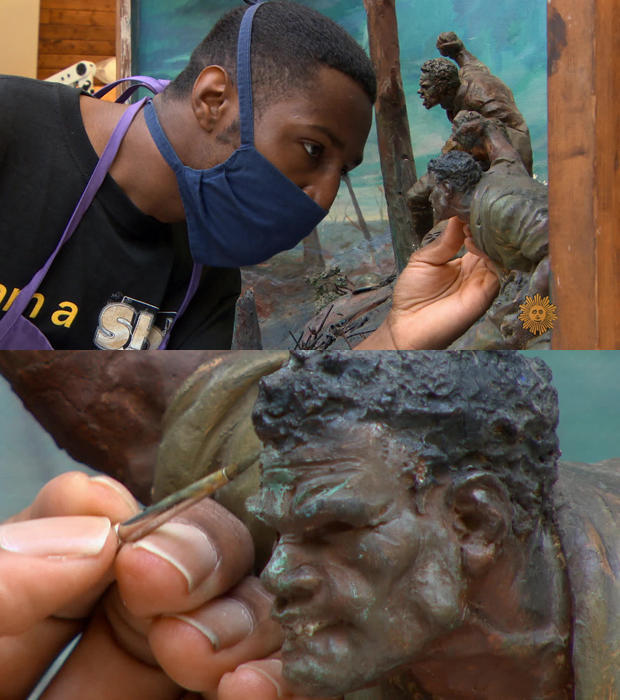
HBCU students participate through the fully-funded Six Week Introduction to Practical Conservation (SIPC) administered by the HBCU Alliance of Museum and Galleries and The University of Delaware with financial support from the Bank of America Charitable Foundation. To learn more about the application process and to apply for upcoming opportunities please click here.
As of August 2024, eight dioramas have been fully restored and are on display in the Legacy Museum.
Roger Blakemore restored the diorama commemorating the Harlem Hell fighters, an infantry troop regiment that was one of the first to serve in World War II.
Programming / Events
We are pleased to offer a rotating calendar of events and programming in conjunction with other departments, student organizations, and community organizations. Check our social media for the most up to date information about our past, current, and upcoming events.
Contact us to via email to learn more about potential collaboration or hosting opportunities.
Gift Shop Information
We are pleased to offer branded t-shirts (S-3XL), ceramic mugs, aluminum water bottles, keychains, pins, magnets, posters, and an assortment of books for purchase in the Legacy Museum.
We can currently accept cash, Cashapp, Venmo, and Paypal payments.
Contact Us and Follow Us
Phone: 334-724-4485 Email: legacymuseum@tuskegee.edu LOCATION (Entrance to Campus): 1200 W. Montgomery Rd., Tuskegee, AL 36088
Continue down Booker T. Washington Blvd. to the 4-way stop. The Legacy Museum is on your left.